Key Findings: Virginia Cannabis at a Glance
- Status: Fully legal for adults 21+
- Legislation: HB 2312 / SB 1406, signed April 2021
- Personal possession legal: July 1, 2021
- Retail sales launched: January 1, 2024
- Public Possession: 1 oz (28g) flower
- Home Possession: Up to 1 pound (453g)
- Home Grow: 4 plants per household
- Regulators: Virginia Cannabis Control Authority (CCA) + VDACS + ABC
- Excise Tax: 12% + 2.5% state sales tax
- Social Equity: Dedicated provisions in the licensing framework
Legal Status Overview
Virginia’s path to full cannabis legalization was deliberately phased. Governor Ralph Northam signed HB 2312 and SB 1406 in April 2021, making Virginia the first Southern state to legalize adult-use cannabis through its legislature (rather than ballot initiative). The law made personal possession of up to 1 ounce legal on July 1, 2021, allowing adults to possess, consume, and gift cannabis — but without a retail framework yet in place.
Retail sales were deliberately delayed to allow the General Assembly to establish the regulatory and licensing structure. After extensive legislative debate, Virginia’s licensed adult-use retail market launched on January 1, 2024. This meant there was a roughly 2.5-year window during which possession was legal but licensed stores did not yet exist for recreational sales, creating unusual market dynamics.
The Virginia Cannabis Control Authority (CCA), along with the Department of Agriculture and Consumer Services (VDACS) and the Alcoholic Beverage Control Authority (ABC), oversee different aspects of Virginia’s cannabis ecosystem. Social equity is a central pillar of the legislative framework, with dedicated licensing tiers, fee reductions, and community reinvestment provisions aimed at addressing the disproportionate impact of prior cannabis enforcement.
Virginia’s cannabis geography reflects deep cultural and political divides: Northern Virginia (the DC suburbs) embraces the legal market enthusiastically with high dispensary density and consumer demand. Rural Virginia — particularly the southwest and Southside regions — has fewer dispensaries, lower consumer density, and in some localities, more adversarial official attitudes despite the state framework.
Possession Limits
| Situation |
Legal Limit |
Penalty if Over |
| Public (adult 21+) |
1 oz (28g) flower |
1oz–1lb: civil penalty / $25 fine; over 1lb: criminal |
| Private residence |
1 pound (453g) |
Felony distribution charges possible |
| Gifting (adult to adult) |
Up to 1 oz with no compensation |
Sale without license = criminal |
| Under 21 (non-patient) |
Zero tolerance |
Civil penalty; under 18 = juvenile proceedings |
| Federal land / military |
Federal law (zero tolerance) |
Federal charges |
Home Cultivation Rules
Virginia law permits adults 21 and older to cultivate cannabis plants at home for personal use:
- Plant limit: Up to 4 plants per household (not per person)
- Tagging requirement: Each plant must be tagged with the grower’s name, driver’s license number, and a notation that it is for personal use
- Visibility: Plants must not be visible from a public way without the use of aircraft, binoculars, or other visual aids
- Security: Must not be accessible to individuals under 21
- No commercial sales: Home-grown cannabis may not be sold; personal gifting of 1 oz or less is permitted
- Landlord rights: Landlords and property owners may prohibit cultivation; HOAs may have additional restrictions
- Federal housing: Residents of federally subsidized housing may not cultivate regardless of state law
Medical Cannabis Program
Virginia’s medical cannabis program predates adult-use legalization and remains active, offering advantages for qualifying patients:
- Medical cannabis has been available in Virginia since 2018 under pharmaceutical processor licenses
- Qualifying conditions: Any diagnosed condition or disease at the discretion of a licensed practitioner (Virginia uses a broad practitioner-certification model rather than a restrictive qualifying condition list)
- Registration: Patients register through the Board of Pharmacy’s patient registration system
- Possession for patients: A 90-day supply as certified by the practitioner; typically more than the 1-oz recreational limit
- Tax benefits: Medical cannabis purchases are exempt from the 12% adult-use excise tax
- Product forms: Virginia medical dispensaries carry flower, oils, tinctures, capsules, and topicals
- Minors: Minors may use medical cannabis with parental consent and practitioner certification
Dispensary Rules and Retail
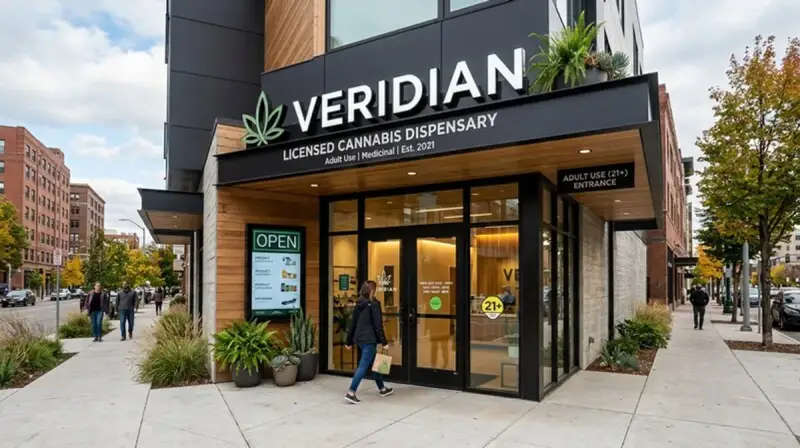
Virginia’s adult-use retail market launched January 1, 2024. The Cannabis Control Authority oversees licensing:
- License types include: cultivator, manufacturer, retailer, wholesaler, and independent testing laboratory
- Social equity applicants receive priority review and reduced application fees under the CCA framework
- Retail stores may not be within 1,000 feet of a K-12 school, daycare, or playground (local zoning may impose additional distance requirements)
- Hours of sale regulated by locality; most retailers operate 9am–9pm or similar
- Online ordering and curbside pickup permitted; home delivery rules vary by locality
- Advertising must not target individuals under 21
- All products must carry state-mandated laboratory analysis labels with THC/CBD content per unit
- Northern Virginia (Fairfax, Arlington, Alexandria) has the highest concentration of licensed retailers; rural areas in the southwest and Southside have fewer options
Cannabis Taxes in Virginia
| Tax |
Rate |
Notes |
| State excise tax (retail) |
12% |
Adult-use retail only |
| State sales tax |
2.5% |
All cannabis sales (lowest combined rate in legal states) |
| Additional state cannabis tax |
2.5% |
Separate from general sales tax |
| Local option tax |
Up to 3% |
At local discretion |
| Effective combined rate (rec) |
~15%–18% |
One of the lower combined rates among legal states |
Revenue from cannabis taxes is distributed to: public health programs (40%), K-12 education (30%), community reinvestment funds in areas disproportionately impacted by prior drug enforcement (25%), and administrative costs (5%).
DUI and Impaired Driving
Virginia uses an impairment-based standard for cannabis DUI rather than a per se blood-concentration limit:
- No legal per se THC blood concentration threshold; impairment must be demonstrated
- Officers may conduct standardized field sobriety testing and request blood tests; blood THC levels can be used as evidence of impairment but are not automatically conclusive
- A first-offense DUI conviction in Virginia carries: 12-month license suspension, mandatory alcohol safety action program (ASAP) enrollment, fines starting at $250, and possible jail time for egregious cases
- Cannabis and alcohol combined DUI is treated more seriously than single-substance impairment
- Virginia law prohibits having an open cannabis container in the passenger compartment of a vehicle; cannabis must be in a sealed original package or in the trunk
- Consuming cannabis in a vehicle (by driver or passenger) while the vehicle is in operation is prohibited
Employment and Housing Rights
Virginia enacted employee protections for adult cannabis users as part of its legalization framework, though these protections have important limitations:
- Employers generally may not take adverse action against an employee solely for lawful cannabis use during non-work hours away from the workplace
- Employers retain the right to prohibit impairment at work and to maintain drug-free workplace policies for safety-sensitive roles
- Federal contractors, DOT-regulated positions, and safety-sensitive industries are excluded from state employment protections
- Virginia employers may not request information about an applicant’s past cannabis use if those past offenses have been expunged
- Medical cannabis patients registered with the Board of Pharmacy have additional statutory protections against employer discrimination
- Housing: Landlords may prohibit cannabis use (including smoking) on their properties; tenants in federally subsidized housing (public housing, Section 8) remain subject to federal prohibition rules; private landlords increasingly include specific cannabis clauses in lease agreements
Social Equity Provisions
Virginia’s cannabis legislation explicitly recognizes and attempts to address the historical disproportionate enforcement of drug laws on Black and lower-income communities:
- Social equity applicants (defined by criteria including prior cannabis convictions, residency in disproportionately impacted communities, and income) receive priority licensing review
- Reduced application and licensing fees for qualifying social equity applicants
- A dedicated Cannabis Equity Reinvestment Fund receives a portion of tax revenue for community programs, workforce development, and support services in affected communities
- The Cannabis Control Authority’s board composition requirements include representation from social equity communities
- Technical assistance programs provide support to equity applicants who may lack business development experience
Expungement and Past Convictions
Virginia created an automatic expungement mechanism for certain past cannabis convictions as part of its legalization package:
- Simple possession convictions for amounts that are now legal are eligible for automatic expungement through the courts
- Virginia’s Supreme Court issued orders directing the automatic sealing of eligible records
- Not all prior cannabis convictions are eligible: offenses involving sale, distribution, or quantities above current legal limits require individual petitions
- Individuals may also petition proactively for expungement of eligible records through the circuit court process
- Federal convictions and convictions on federal property are not affected by state expungement
Public Consumption Rules
Cannabis consumption in public spaces is prohibited throughout Virginia:
- Streets, parks, plazas, and all public spaces are prohibited consumption areas
- Consumption in a vehicle or on school property is specifically prohibited and carries enhanced penalties
- No cannabis lounges or social consumption establishments are currently licensed in Virginia
- Hotels and rental properties: must have owner’s permission; smoking restrictions may apply even with permission
- First offense public consumption: civil penalty up to $25
- Consumption within 1,000 feet of a school when children are present carries higher civil penalties
Federal vs. State Law in Virginia
Virginia has a particularly dense federal presence including the Pentagon, numerous military bases, and extensive federal agency headquarters in Northern Virginia. Key federal conflicts:
- The Pentagon, CIA, NSA, and other federal agencies require employees to be free of cannabis regardless of Virginia law
- National parks, Shenandoah National Park, and Colonial/Fredericksburg historical sites are federal jurisdiction where cannabis prohibition applies
- Many Northern Virginia residents work for the federal government or federal contractors — a significant practical complication given the region’s cannabis culture
- Security clearances: cannabis use can affect federal security clearance eligibility despite state legality; federal agencies assess this on a case-by-case basis but recent use is typically disqualifying
- Banking: Virginia cannabis businesses face the same federal banking limitations as all cannabis businesses; cash remains common
Video: Virginia Cannabis Law — From Legislation to Retail
Understand Virginia’s phased legalization timeline, the launch of retail in January 2024, and what it means for residents in Northern Virginia vs. rural parts of the state.
Browse All State Laws
MW
Marcus Webb
Cannabis Law & Policy Writer at ZenWeedGuide. Marcus covers US state cannabis legislation, regulatory changes, and consumer rights across all 50 states. His work focuses on translating complex legal language into actionable information for consumers, patients, and cannabis business operators.
Frequently Asked Questions
Is weed legal in Virginia?
Yes. Virginia legalized adult-use cannabis in 2021 (personal possession from July 2021; licensed retail from January 2024). Adults 21+ may possess, purchase, consume, and cultivate within the legal limits.
Can you buy weed in Virginia without a medical card?
Yes. Since January 1, 2024, any adult 21+ with a valid ID can purchase cannabis at a licensed adult-use retail store without a medical card. Medical card holders get lower tax rates and higher purchase limits.
Can I get fired for using weed in Virginia?
Generally, Virginia employers cannot fire you solely for lawful off-duty cannabis use. However, safety-sensitive roles and federally regulated employers (a significant category in Northern Virginia) are exempt from these protections.
Is cannabis legal in Northern Virginia?
Yes. The same state law applies statewide. Northern Virginia (Arlington, Fairfax, Alexandria) has high dispensary density and is the most active market in the state. The main caveat for NOVA is the concentration of federal employees and contractors who may be subject to federal drug policies regardless of state law.
What happens if you have more than 1 ounce in public in Virginia?
Possession of more than 1 oz but no more than 1 lb in public is a civil penalty with a fine of up to $25 for a first offense. Possession of more than 1 pound is a criminal offense that can result in felony charges for distribution or intent to distribute.
Disclaimer: This page is for informational purposes only and does not constitute legal advice. Cannabis laws change frequently. Always verify current regulations with the Virginia Cannabis Control Authority (CCA) at cca.virginia.gov or consult a licensed attorney for your specific situation.