
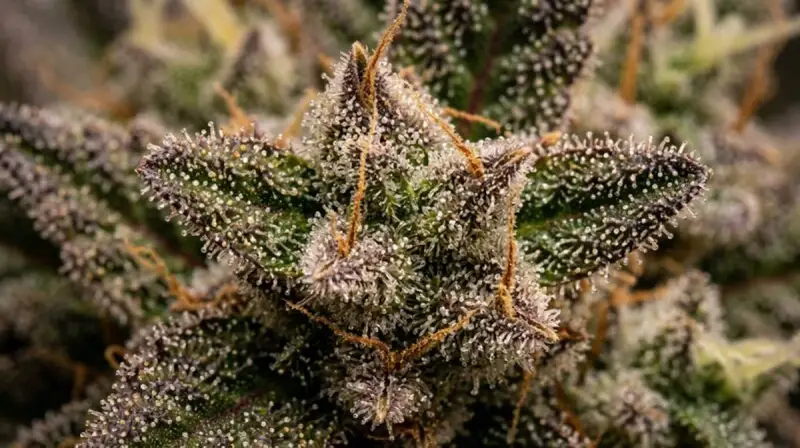









- Aroma: Sharp, intensely fresh mint with camphor and peppermint character — the primary scent compound of pennyroyal mint.
- Chemical class: Monocyclic monoterpene ketone (p-menth-8-en-3-one, C10H16O) — the ketone functional group distinguishes it from hydrocarbon terpenes and drives its unique biological activity.
- Boiling point: 224°C (435°F) — vaporizes within high-temperature cannabis consumption ranges; survives some vaporizer profiles.
- Primary effects: Acetylcholinesterase inhibition (memory-relevant cholinergic enhancement), sedation/CNS depression in animal models, antimicrobial activity in food safety research.
- Top strains: Bubba Kush, Blue Cheese, Trainwreck, Peppermint Kush (all trace-level detection only).
- Entourage role: Theoretical AChE inhibition synergy with alpha-pinene (also an AChE inhibitor); complementary sedation with linalool via separate CNS pathways.
- Natural sources: Pennyroyal (Mentha pulegium, 50–80% EO), peppermint, spearmint, catnip — all mint-family plants.
Chemical Properties
Pulegone (p-menth-8-en-3-one) is a monocyclic monoterpene ketone belonging to the menthane family of compounds, which includes menthol, menthone, carvone, and piperitone. The ketone carbonyl group at carbon-3 of the cyclohexane ring gives pulegone its distinctive reactivity profile and distinguishes it from the overwhelming majority of cannabis terpenes, which are hydrocarbons or alcohol terpenoids. Pulegone is biosynthetically upstream in the menthol pathway — it is converted to (+)-isomenthone and then to menthol through successive enzymatic reductions. Learn more about terpene chemistry fundamentals.
| Property | Value |
|---|---|
| IUPAC name | (R)-(+)-p-Menth-8(20)-en-3-one / (4R)-4-methyl-1-(propan-2-ylidene)cyclohexan-2-one |
| Molecular formula | C10H16O |
| Molecular weight | 152.23 g/mol |
| Boiling point | 224°C (435°F) |
| Aroma profile | Intense mint, peppermint, camphor, herbaceous, slightly woody |
| Typical cannabis concentration range | 0.001–0.05% (often below detection threshold; rarely >0.10%) |
| Solubility | Very low water solubility; high lipid solubility; miscible with ethanol and organic solvents |
| Functional group | Ketone (enone subtype — α,β-unsaturated carbonyl) |
| EFSA status | Restricted as food flavoring (2014) — genotoxicity concerns at high cumulative dietary intake |
| FDA status | GRAS revoked for high-level food flavoring use; naturally occurring trace levels not restricted |
Biosynthesis: How Pulegone Is Produced
In mint plants (Mentha spp.), pulegone sits at a central junction of the menthol biosynthetic pathway. The pathway begins with the MEP (methylerythritol phosphate) route in plastids, which generates geranyl pyrophosphate (GPP, C10). The monoterpene synthase limonene synthase converts GPP to (+)-limonene, which is then hydroxylated by a cytochrome P450 enzyme (limonene-3-hydroxylase) to yield (+)-trans-isopiperitenol. A series of oxidation and reduction reactions — catalyzed by isopiperitenol dehydrogenase, isopiperitenone reductase, and isopulegone isomerase — eventually yields (+)-pulegone. Subsequent reduction by pulegone reductase converts pulegone to (+)-isomenthone, and further reductions produce (–)-menthol.
In cannabis, pulegone biosynthesis is not well characterized. Cannabis does not encode the full mint menthol pathway, and pulegone in cannabis likely arises as a low-level shunt product or trace metabolite from a related monoterpene pathway rather than from dedicated enzymatic synthesis. This explains why concentrations are so much lower in cannabis (micrograms per gram) than in mint plants (hundreds of milligrams per gram of essential oil). The specific terpene synthase or P450 responsible for trace pulegone production in cannabis has not been identified in published literature.
Mechanism of Action
Acetylcholinesterase (AChE) inhibition: Pulegone’s most pharmacologically notable activity is inhibition of acetylcholinesterase, the enzyme that hydrolyzes the neurotransmitter acetylcholine (ACh) into choline and acetate at synaptic junctions throughout the central and peripheral nervous system. By slowing ACh breakdown, AChE inhibitors prolong and amplify cholinergic neurotransmission — enhancing signal strength at muscarinic and nicotinic ACh receptors. Cholinergic pathways are central to memory consolidation (especially in the hippocampus), attention regulation, and arousal state maintenance.
This is precisely the mechanism exploited by the most widely prescribed Alzheimer’s disease medications: donepezil (Aricept), rivastigmine (Exelon), and galantamine (Reminyl). All three are AChE inhibitors approved for slowing cognitive decline in Alzheimer’s dementia. The research by Amaeze et al. (2014) documented pulegone’s AChE inhibitory capacity in vitro, with IC50 values in a pharmacologically relevant range. Whether cannabis-delivered microgram quantities of pulegone contribute meaningfully to AChE inhibition in human subjects is unknown and would require specific pharmacokinetic modeling and clinical investigation.
TRPM8 receptor interaction: As a member of the mint terpene family, pulegone may interact with TRPM8, the thermosensitive TRP channel responsible for the sensation of cold and menthol-induced cooling. TRPM8 is expressed in sensory neurons, the bladder, and prostate tissue. Whether pulegone is a TRPM8 agonist, partial agonist, or modulator at physiologically relevant concentrations has not been definitively established, but the structural similarity to established TRPM8 ligands (menthol, icilin) makes this a plausible target.
Hepatotoxic metabolic pathway (high-dose only): At high doses — as seen in pennyroyal oil poisoning — pulegone undergoes hepatic biotransformation to reactive electrophilic intermediates. The primary toxic pathway involves cytochrome P450-mediated oxidation to pulegone epoxide and then to the highly reactive menthofuran, which depletes hepatic glutathione and generates reactive oxygen species, leading to centrilobular hepatic necrosis. This pathway is well-characterized in animal models and human poisoning case reports. At the microgram quantities delivered by cannabis, this metabolic pathway is not activated to any clinically meaningful degree.
Medical Evidence Summary
| Effect / Application | Study / Source | Model Type | Dose | Outcome | Evidence Quality |
|---|---|---|---|---|---|
| AChE inhibition (memory) | Amaeze et al., 2014 (Pharm Biol) | In vitro enzyme inhibition assay; Nigerian folk medicine research context | IC50 ~18–35 µg/mL range | Significant AChE inhibition; comparable to physostigmine in assay conditions; context: traditional cognitive medicine | Early (in vitro) |
| Sedation / CNS depression | Matos et al., 1996 (Planta Med) | Mouse model, pentobarbital sleep potentiation; open field | 100–400 mg/kg oral | Dose-dependent CNS depression; prolonged sleep time; reduced locomotor activity; no anxiolysis at low dose | Moderate (animal) |
| Hepatotoxicity (high-dose) | Gordon et al., 1987 (Biochem Pharmacol) | Rat model, pure pulegone compound | 150–400 mg/kg i.p. | Hepatic glutathione depletion, menthofuran formation, centrilobular necrosis; dose-dependent toxicity | Strong (animal) — irrelevant to cannabis doses |
| EFSA Genotoxicity Review | EFSA ANS Panel, 2014 (EFSA Journal) | Regulatory review, Ames test + in vivo clastogenicity data | Chronic dietary exposure modeling | Genotoxic potential identified; margin of exposure (MoE) insufficient for unrestricted food flavoring use; restriction issued | Strong (regulatory) |
| Antimicrobial (food safety) | Mimica-Dukic et al., 2003 (Phytomedicine) | In vitro MIC broth dilution | MIC 0.5–4.0 mg/mL | Active against Listeria monocytogenes and Salmonella spp.; moderate efficacy vs. gram-negative organisms | Moderate (in vitro) |
| Anti-proliferative | Aeschbach et al., 2007 (Food Chem Toxicol) | In vitro, various cancer cell lines | 10–100 µM | Cytostatic activity in some cell lines; concentration-dependent; mechanism uncharacterized | Early (in vitro) |
| Anti-inflammatory | de Sousa et al., 2006 (J Ethnopharmacol) | Rat carrageenan paw edema | 50 mg/kg oral | Moderate reduction in edema; prostaglandin pathway modulation proposed; effect smaller than reference NSAIDs | Low–Moderate (animal) |
Cannabis Strains Where Pulegone Has Been Detected
Pulegone is so rare in cannabis that many standard terpene panels do not include it, and analytical labs with detection limits above 0.01% will simply report it as not detected. The strains below have had pulegone reported on third-party lab results with sufficient frequency to be considered characteristic detections. Always check current COA data. Browse the full strain library.
| Strain | Type | Pulegone Detection Range | Dominant Terpenes | Profile Notes |
|---|---|---|---|---|
| Bubba Kush | Indica-dominant | Trace (0.001–0.04%) | myrcene, caryophyllene, Limonene | Earthy, coffee-hash aroma; pulegone adds subtle herbal note in some phenotypes |
| Blue Cheese | Indica-dominant | Trace (0.002–0.05%) | Myrcene, Caryophyllene, Linalool | Complex earthy-cheese profile; pulegone rarely detected but recorded in select COAs |
| Trainwreck | Hybrid (Sativa-leaning) | Trace (0.002–0.04%) | Terpinolene, Myrcene, Ocimene | Minty-herbal undertones in some phenotypes correlate with pulegone presence |
| Peppermint Kush | Indica-dominant | Trace (0.005–0.08%) | Myrcene, Caryophyllene, Linalool | Named for minty aroma; pulegone is a likely contributor to the cooling herbal note |
| OG Kush (select phenotypes) | Hybrid | Trace (0.001–0.03%) | Myrcene, Limonene, Caryophyllene | Inconsistent detection across batches; not a defining terpene for this cultivar |
| Headband | Hybrid | Trace (0.001–0.02%) | Myrcene, Caryophyllene, Limonene | Complex multi-terpene profile; pulegone in some batch COAs |
Entourage Effect: Synergy Potential
Pulegone’s entourage synergy potential is primarily theoretical given its trace concentrations in cannabis. The AChE inhibition mechanism is the most pharmacologically interesting basis for synergy discussion. The most compelling potential interaction is with alpha-pinene, which is also documented as an AChE inhibitor. Full terpene synergy context in our terpene guide.
| Partner Compound | Potential Combined Effect | Mechanistic Basis | Evidence Level |
|---|---|---|---|
| Alpha-Pinene | Stacked AChE inhibition — memory and focus support | Alpha-pinene is independently documented as an AChE inhibitor (Perry et al., 2000); additive inhibitory effect theoretically plausible; both present in some complex cultivar profiles | Theoretical — mechanistically coherent but no co-administration data |
| CBD | Neuroprotective and memory support combination | CBD’s neuroprotective mechanisms (BDNF upregulation, neuroinflammation reduction) + pulegone AChE inhibition (cholinergic support); complementary cognitive pharmacology | Theoretical — no co-administration study; mechanistically plausible |
| Linalool | Enhanced sedation and anxiolysis | Both have CNS depressant properties; linalool modulates GABA-A receptors; pulegone potentiates pentobarbital sleep in animal models; combined sedation mechanistically plausible via separate pathways | Theoretical — both compounds individually studied; no combined data |
| Myrcene | Additive sedation, possible entourage analgesic | Myrcene is strongly sedative via GABA pathway; pulegone’s CNS depressant effect at any relevant dose adds potential synergy; both in indica-dominant profiles | Plausible — individually documented sedative mechanisms |
Non-Cannabis Natural Sources of Pulegone
| Plant | Part | Approximate Concentration |
|---|---|---|
| Mentha pulegium (pennyroyal) | Aerial parts essential oil | 50–80% of EO — primary natural source; medicinal use dangerous due to hepatotoxicity at these concentrations |
| Mentha piperita (peppermint) | Leaf essential oil | 1–10% (varies by chemotype); significant in trace-pulegone chemotypes |
| Mentha spicata (spearmint) | Leaf essential oil | Trace to 3% — minor mint-pathway product |
| Nepeta cataria (catnip) | Aerial parts essential oil | Trace amounts alongside nepetalactone; minor component |
| Rosmarinus officinalis (rosemary) | Leaf essential oil | Trace (some chemotypes); very minor component |
| Cannabis (Cannabis sativa L.) | Trichome-bearing flower | 0.001–0.05% of dry weight — one of the rarest detectable terpenes |
Extraction, Industrial & Commercial Uses
Pulegone is commercially produced almost exclusively from pennyroyal essential oil via steam distillation of Mentha pulegium aerial parts. Pennyroyal has historically been cultivated in Mediterranean Europe, North Africa, and the Middle East, and its essential oil was used as a flea repellent, insecticide, and abortifacient in folk medicine — the latter use being extremely dangerous due to hepatotoxicity. Commercial pulegone is now primarily obtained for analytical reference standards, flavor research, and limited specialty fragrance applications.
In food science, pulegone has been used as a flavoring agent to impart peppermint character to confectionery, gum, and beverages, though the EFSA 2014 restriction and subsequent regulatory actions in EU member states have significantly reduced its permitted application levels. The FDA’s GRAS status for pulegone at high use levels has similarly been questioned, leading most large manufacturers to replace it with menthol, L-carvone, or other mint compounds with cleaner safety profiles.
In fragrance, pulegone contributes minty-herbaceous top notes to some perfumery compositions, though its use is minor compared to other mint compounds. Cosmetic use is limited and subject to concentration restrictions in some regulatory frameworks due to sensitization potential at high concentrations. Cannabis-derived pulegone is not commercially relevant in isolation given its extremely low concentrations in flower.
Safety & Toxicology
The safety profile of pulegone is uniquely two-tiered: at trace cannabis concentrations it presents no established risk, but it becomes genuinely hazardous at the high doses found in concentrated pennyroyal preparations. This distinction is essential for evidence-based assessment.
At cannabis concentrations (micrograms/session): No meaningful toxicological risk. The metabolic pathway generating hepatotoxic intermediates (menthofuran, pulegone epoxide) requires substantial hepatic P450 processing of milligram quantities. Consumer cannabis sessions deliver an estimated 1–50 micrograms of pulegone — well below any toxicologically relevant threshold. The EFSA restriction on food flavoring applies to scenarios of regular, substantial dietary intake from artificially pulegone-enriched foods, not to botanical trace amounts.
At pennyroyal oil doses (milligrams to grams): Documented severe hepatotoxicity in multiple human poisoning case reports. Symptoms include nausea, vomiting, abdominal pain, and elevated liver enzymes progressing to fulminant hepatic failure at very high doses. Several fatalities have been attributed to pennyroyal oil ingestion, particularly in attempted abortions. This risk is entirely irrelevant to cannabis consumption.
Genotoxicity concern: The EFSA 2014 review identified genotoxic potential in Ames test assays and in vivo clastogenicity studies at high pulegone doses. The margin of exposure calculation was insufficient to support unrestricted food additive use. Again, this concern applies to scenarios of repeated substantial dietary intake, not to trace botanical quantities.
For cannabis consumers specifically: no special precautions regarding pulegone are warranted. It is one of hundreds of trace compounds in cannabis flower, present at levels that are toxicologically insignificant. The scientific documentation of its hazard at high doses is included here for complete accuracy, not because it represents a risk in the context of cannabis use.
Cannabis Terpene Science — Video
Frequently Asked Questions
Is pulegone safe in cannabis?
At the trace concentrations found in cannabis flower (typically 0.001–0.05%), pulegone is not considered a safety concern. Hepatotoxicity associated with pulegone applies to concentrated pennyroyal oil preparations where doses reach tens of milligrams of pure compound. Cannabis delivers pulegone in microgram quantities — several orders of magnitude below hepatotoxic thresholds. The EFSA restriction applies to cumulative dietary intake from food flavoring additives, not trace terpene components of botanical products.
Does pulegone improve memory?
Preclinical research shows pulegone inhibits acetylcholinesterase (AChE), slowing acetylcholine breakdown and theoretically enhancing cholinergic neurotransmission involved in memory. This is the same mechanism used by Alzheimer’s drugs like donepezil. However, research doses far exceed what cannabis can deliver, and no human trials confirm memory-enhancing effects from cannabis-derived pulegone. The mechanism is scientifically notable but not clinically validated for cannabis application.
What does pulegone smell like?
Pulegone has a sharp, intensely fresh minty aroma with camphor and peppermint notes. It is the primary odor compound in pennyroyal mint and contributes distinctive freshness to spearmint and peppermint oils. In cannabis at trace levels it adds a subtle cool, herbal freshness without being identifiable as a separate aromatic note.
Which cannabis strains contain pulegone?
Pulegone is among the rarest terpenes in cannabis. It has been detected at trace levels in select phenotypes of Bubba Kush, Blue Cheese, Trainwreck, Peppermint Kush, and OG Kush. Because concentrations are so low (typically below 0.05%), it is rarely listed on standard lab reports and does not define the pharmacological profile of any cultivar.
What is the difference between pulegone and menthol?
Pulegone is a ketone and biosynthetic precursor; menthol is an alcohol and the final cooling product of the same mint pathway. Menthol acts on TRPM8 cold receptors to produce the characteristic cooling sensation of peppermint. Pulegone is biosynthetically upstream — it is converted through menthone to menthol in mint plants. Both belong to the menthane family of monoterpenes; only pulegone occurs in trace amounts in cannabis.
Why did EFSA restrict pulegone in food products?
The EFSA restricted pulegone as a food flavoring additive in 2014 following a genotoxicity re-evaluation. At cumulative dietary intake levels possible through regular consumption of pulegone-containing foods, EFSA calculated that the margin of exposure did not provide sufficient safety assurance given genotoxic potential at high doses in animal studies. This decision does not apply to naturally occurring trace amounts in botanical products such as cannabis or herbal teas, where exposure is far lower.