







- Both are fruity indica-dominant classics with devoted fan bases and strong flavor identities.
- Lineage divergence: Cherry Pie = Granddaddy Purple × Durban Poison. Blueberry = DJ Short’s Afghan × Thai × Purple Thai selection.
- Effects: Cherry Pie is more cerebral-euphoric before settling into relaxation. Blueberry is smoother, more purely physical.
- THC: Cherry Pie 16–23% vs Blueberry 15–20% (traditional; modern up to 23%). Cherry Pie edges higher on average.
- Flavor: Cherry Pie = sweet cherry + berry + earthy. Blueberry = fresh blueberry + tropical + subtle pine.
- Growing: Cherry Pie is more forgiving. DJ Short’s Blueberry is finicky about nutrients and watering.
- Best for anxiety: Blueberry (smoother, less cerebral stimulation at moderate doses).
Lineage Deep Dive: Very Different Family Trees
Despite both being celebrated as “fruity indicas,” Cherry Pie and Blueberry arrive at their flavor and effect profiles through completely different genetic paths — and understanding those paths illuminates why they feel so different to experience.
Cherry Pie: The California Hybrid
Cherry Pie is a relatively modern California hybrid, crossing two iconic strains with very different characters: Granddaddy Purple (the classic West Coast indica known for heavy sedation and grape flavor) and Durban Poison (a pure African sativa landrace from Durban, South Africa, prized for its energetic, clear-headed, and productive high). The cross produces a hybrid that is predominantly indica in its effect — the GDP genetics dominate the body experience — but with a cerebral uplift and euphoric brightness that the Durban Poison parent contributes. This sativa influence makes Cherry Pie more multidimensional than a pure indica, delivering a fast-acting mental lift that precedes the physical relaxation wave.
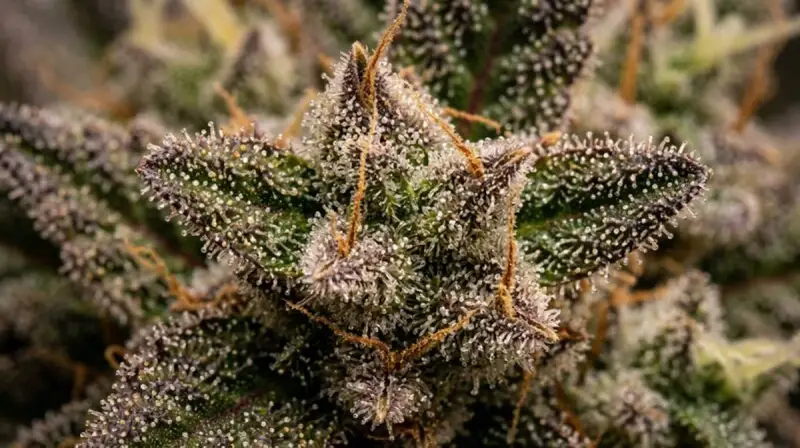
The GDP parent also contributes to Cherry Pie’s visual appeal: dense, medium-sized buds with possible purple hues in cooler growing conditions, heavy trichome coverage, and orange pistils. The Durban Poison influence is visible in the plant’s slightly taller structure compared to a pure indica. See our strain genetics section for the complete GDP and Durban Poison profiles.
Blueberry: DJ Short’s Masterpiece
Blueberry represents a completely different tradition in cannabis breeding — the patient, multi-generational work of DJ Short, who spent decades in the 1970s and 80s developing his signature blue-hued, berry-flavored strains from carefully chosen landrace combinations. The primary crosses underlying DJ Short’s Blueberry involve Afghan indica (for body effect, density, and resin production), Thai sativa (for cerebral uplift, yield, and flavor complexity), and Purple Thai (for the distinctive color and fruity terpene enhancement).
DJ Short’s Blueberry won the Cannabis Cup in 2000 and remains one of the most critically acclaimed strains in cannabis history — valued not for raw THC numbers but for the exceptional quality and purity of its experience. The high is smooth, even, and deeply satisfying. The flavor is genuinely unique. The plant produces buds that develop striking blue-purple coloration even without extreme temperature manipulation. It’s a strain that rewards patience and appreciation — the opposite of the “more is more” philosophy of modern high-THC breeding.
Side-by-Side Comparison Table
| Criteria | Cherry Pie | Blueberry (DJ Short) |
|---|---|---|
| Primary Parents | Granddaddy Purple × Durban Poison | Afghan × Thai × Purple Thai |
| Breeder Origin | California (attributed to Mr. Sherbinski) | DJ Short (Pacific Northwest, 1970s–80s) |
| Classification | Indica-dominant Hybrid (80% indica) | Indica-dominant (80% indica) |
| Average THC | 16–23% | 15–20% (traditional); up to 23% (modern) |
| CBD Content | 0.1–0.3% | 0.2–0.5% |
| Dominant Terpenes | Caryophyllene, Myrcene, Limonene | Myrcene, Linalool, Terpinolene |
| Secondary Terpenes | Linalool, Pinene | Ocimene, Pinene, Caryophyllene |
| Flavor Profile | Sweet cherry, berry, earthy, slight sourness | Fresh blueberry, tropical, light pine, berry |
| Aroma | Sweet cherry pie, earthy-fruity | Fresh blueberry, slightly floral, earthy |
| Effect Character | Euphoric onset → physical relaxation | Smooth, even body high, calm euphoria |
| Cerebral Activity | Moderate-High (initial) | Low-Moderate |
| Sedation Level | High | High |
| Best Time of Day | Evening | Evening to nighttime |
| Duration | 2–3 hours | 2–4 hours |
| Medical Uses | Stress, pain, insomnia, depression | Insomnia, chronic pain, anxiety, PTSD |
| Growing Difficulty | Intermediate | Intermediate–Advanced |
| Flowering Time | 56–63 days (8–9 weeks) | 56–65 days (8–9 weeks) |
| Indoor Yield | 400–500 g/m² | 350–450 g/m² |
| Plant Height | Medium (70–110 cm) | Short-Medium (60–100 cm) |
| Color Expression | Purple possible (GDP heritage) | Blue-purple (reliable, signature trait) |
Terpene Breakdown: The Chemistry of Fruitiness
Cherry Pie Terpene Profile
| Terpene | Aroma Contribution | Effect Contribution |
|---|---|---|
| Caryophyllene (dominant) | Spicy-sweet depth, slight cherry warmth | Anti-inflammatory, CB2 activation, stress relief |
| Myrcene | Earthy-fruity base, enhances sweetness | Sedation, muscle relaxation, indica body high |
| Limonene | Bright cherry-citrus top notes | Mood elevation, initial euphoric uplift |
| Linalool | Floral softness | Anxiety reduction, sedation enhancement |
| Pinene | Faint herbal-earthy undertone | Anti-inflammatory, memory retention |
Blueberry Terpene Profile
| Terpene | Aroma Contribution | Effect Contribution |
|---|---|---|
| Myrcene (dominant) | Rich berry-earth, enhances fruity character | Primary sedation driver, deep body relaxation |
| Linalool (co-dominant) | Floral, sweet-berry notes, lavender edge | Anxiety reduction, sleep promotion, smooth sedation |
| Terpinolene | Fresh, fruity-floral, tropical notes | Mildly uplifting, antioxidant |
| Ocimene | Sweet, tropical, slightly herbal | Uplifting contribution, freshness |
| Pinene | Clean piney base note | Mental clarity, bronchodilator |
The key terpene difference is caryophyllene’s prominence in Cherry Pie versus linalool’s prominence in Blueberry. Caryophyllene brings spicy warmth and CB2 receptor activity, contributing to Cherry Pie’s slightly more energetic opening effect. Linalool (also the dominant compound in lavender) is specifically associated with calm, smooth sedation and anxiety relief — which explains why Blueberry produces such a distinctly mellow, anxiety-friendly body experience. Explore our complete terpene guide for detailed profiles.
Effects Deep Dive
Cherry Pie Effect Experience
Cherry Pie opens with a notably fast and euphoric cerebral effect — the Durban Poison genetics contribute an initial brightness and mental energy that catches first-time users by surprise for an indica-dominant strain. This cerebral phase is genuinely pleasant: uplifted mood, social ease, mild creative stimulation. It doesn’t last long before the GDP indica genetics take over, pulling the experience progressively into physical territory. Muscles relax, tension dissolves, and the mental activity quiets into comfortable contentment. At higher doses, deep sedation is the outcome. This two-phase experience makes Cherry Pie unusually versatile for an indica — suitable for social early evenings before transitioning to a relaxing night.
Blueberry Effect Experience
Blueberry’s high is notably different in its evenness. Rather than Cherry Pie’s distinct two-phase progression, Blueberry delivers a smooth, unified experience from the start — a calm, full-body warmth that spreads evenly, with a gentle mood lift that never becomes cerebral enough to stimulate in potentially uncomfortable ways. Long-term cannabis consumers describe Blueberry as profoundly relaxing without being overwhelming — it’s the difference between a deep massage and a nap. The experience is particularly gentle on the mind, making it one of the more reliable strains for anxiety-prone consumers seeking evening relief. At higher doses, Blueberry transitions comfortably into sleep. See our effects library for more on how different terpene profiles shape cannabis experiences.
Medical Applications
| Condition | Cherry Pie | Blueberry | Recommended |
|---|---|---|---|
| Insomnia | Very Good | Excellent | Blueberry |
| Chronic Pain | Very Good | Very Good | Equal |
| Anxiety | Good (moderate doses) | Excellent | Blueberry |
| PTSD | Good | Excellent | Blueberry |
| Depression | Very Good | Good | Cherry Pie |
| Stress Relief | Excellent | Excellent | Equal |
| Muscle Spasms | Good | Very Good | Blueberry |
| Appetite Stimulation | Good | Good | Equal |
| Social Situations | Good (early evening) | Moderate | Cherry Pie |
Educational only. Consult a qualified healthcare provider before using cannabis for any medical condition.
Growing Guide
Growing Cherry Pie
Cherry Pie is accessible for intermediate growers, with wide availability as feminized seeds from numerous reputable breeders. Its GDP heritage contributes to compact, dense bud structure, while the Durban Poison genetics give it slightly more stretch during the transition to flowering — expect moderate height management needs. It responds well to standard feeding schedules with attention to potassium and phosphorus during mid-to-late flower for optimal bud density. Temperature cycling in the final 2 weeks can draw out GDP-inherited purple coloration. Flowering at 8–9 weeks produces moderate-to-good yields of 400–500 g/m² indoors. See our growing guide for detailed nutrition tables.
Growing Blueberry
DJ Short’s Blueberry is a more demanding cultivar that rewards the patient, experienced grower. Its primary sensitivity is to nitrogen — overfeeding nitrogen during late vegetative and early flowering stages produces excess leaf growth at the expense of resin and flavor development. A lighter, more restrained feeding schedule is essential to the best Blueberry expression. Watering frequency also matters: Blueberry performs significantly better with wet-dry cycles than consistent moisture. The plant is compact and doesn’t require significant height management, but environmental control (temperature cycling for color, humidity management to prevent botrytis in dense colas) is important. Authentic DJ Short genetics are worth seeking out — many “Blueberry” products in the market are inferior phenotypes. When grown correctly, the flavor quality is extraordinary.
Frequently Asked Questions
Is Cherry Pie or Blueberry more potent?
Cherry Pie generally tests higher in THC (16–23%) compared to traditional Blueberry (15–20%), though modern Blueberry phenotypes can match Cherry Pie. More importantly, the effect quality differs: Cherry Pie is more cerebral-euphoric, Blueberry smoother and more purely physical. Potency experience depends heavily on individual endocannabinoid system response, not just THC percentage.
What gives Blueberry its taste?
Blueberry’s signature flavor comes from a combination of myrcene (earthy-fruity base), linalool (floral-berry notes), and terpinolene (fresh-fruity lift), developed through DJ Short’s decades of selective breeding. The blue-purple anthocyanin coloration also indicates growing conditions that enhance terpene expression, though color itself doesn’t directly produce flavor.
Which is better for anxiety?
Blueberry is generally the better choice for anxiety-prone consumers due to its smooth, even, primarily physical relaxation with low cerebral stimulation. Cherry Pie’s higher THC ceiling and more pronounced cerebral euphoria can occasionally trigger anxiety at higher doses. Both require starting at low doses for anxiety management.
Which is easier to grow?
Cherry Pie is considerably more forgiving — widely available as stabilized feminized seeds with good environmental adaptability. DJ Short’s Blueberry is nutrient-sensitive and requires experienced growing technique to achieve optimal expression. Intermediate growers: Cherry Pie. Experienced growers seeking a rewarding challenge: Blueberry.
Consumer Profiles: Who Should Choose Each Strain?
Choose Cherry Pie If You:
- Enjoy a fast-hitting initial euphoria before settling into physical relaxation — the two-phase effect profile is its signature characteristic.
- Want a social strain suitable for early evening use before transitioning to night relaxation.
- Are managing depression alongside physical discomfort and want something that addresses both with more mental lift than pure indicas provide.
- Are an intermediate grower looking for a reliable, well-documented strain with broad seed availability and consistent growing characteristics.
- Enjoy fruity cannabis flavors with complexity — the cherry-plus-earthy combination has broader appeal than single-note sweet strains.
- Want a strain that benefits from GDP heritage without committing to GDP’s full knockout sedation.
Choose Blueberry If You:
- Have anxiety or PTSD and need a strain that is reliably non-stimulating at the mental level — Blueberry’s smooth, even effect character is among the best for anxiety-prone consumers.
- Prioritize insomnia relief above all else — Blueberry’s linalool-myrcene profile is specifically well-suited to sleep induction.
- Are a flavor connoisseur who wants one of the most genuinely distinctive, authentic berry flavor profiles in cannabis history.
- Are an experienced grower who enjoys the craft challenge of a nutrient-sensitive strain and wants to experience authentic DJ Short genetics at their best.
- Want a visually beautiful crop — Blueberry’s reliable blue-purple coloration is among the most striking in traditional cannabis genetics.
- Seek a strain with a long track record — Cannabis Cup winner, decades of medical use, and an unimpeachable reputation for quality.
The Shared Foundation: What Both Deliver
For all their differences in lineage and effect character, Cherry Pie and Blueberry share a fundamental identity as premium fruity indicas with strong flavor profiles, reliable physical relaxation, and legitimate medical reputations. Both have survived decades of competitive cannabis culture because they deliver on their promises — not through aggressive THC numbers or flashy marketing, but through genuine terpene quality and consistent therapeutic value. In the current era of ultra-high-THC strains competing for shelf space on potency alone, both Cherry Pie and Blueberry represent a form of cannabis wisdom: the understanding that the most satisfying cannabis experience comes from terpene complexity and balanced effect, not just maximum THC. See our full strain index and terpene library for more on building a cannabis collection based on quality over quantity.