





- Pre-employment is the dominant test type — the vast majority of employer drug screens occur after a conditional offer, before start date.
- Standard test is a urine 5-panel (THC, cocaine, amphetamines, opiates, PCP) — immunoassay screening followed by GC-MS confirmation.
- California, New York, and New Jersey now broadly prohibit pre-employment cannabis screening for most non-safety-sensitive roles.
- Federal contractors have no choice — the Drug-Free Workplace Act and DOT regulations override state law for covered positions.
- Medical marijuana status provides limited employment protection in most states; fewer than 15 states require accommodation for medical users.
- A positive immunoassay must be confirmed by GC-MS before the employer is notified — screening positives alone cannot result in adverse action under federal guidelines.
- You have the right to retest the split specimen through a certified lab — this is your most important procedural right if you believe a result is wrong.
How Pre-Employment Drug Testing Works: The Process
Pre-employment drug testing in the US follows a standardized two-step process for any test that carries employment consequences. Understanding each step is important because you have different rights and options at each stage.
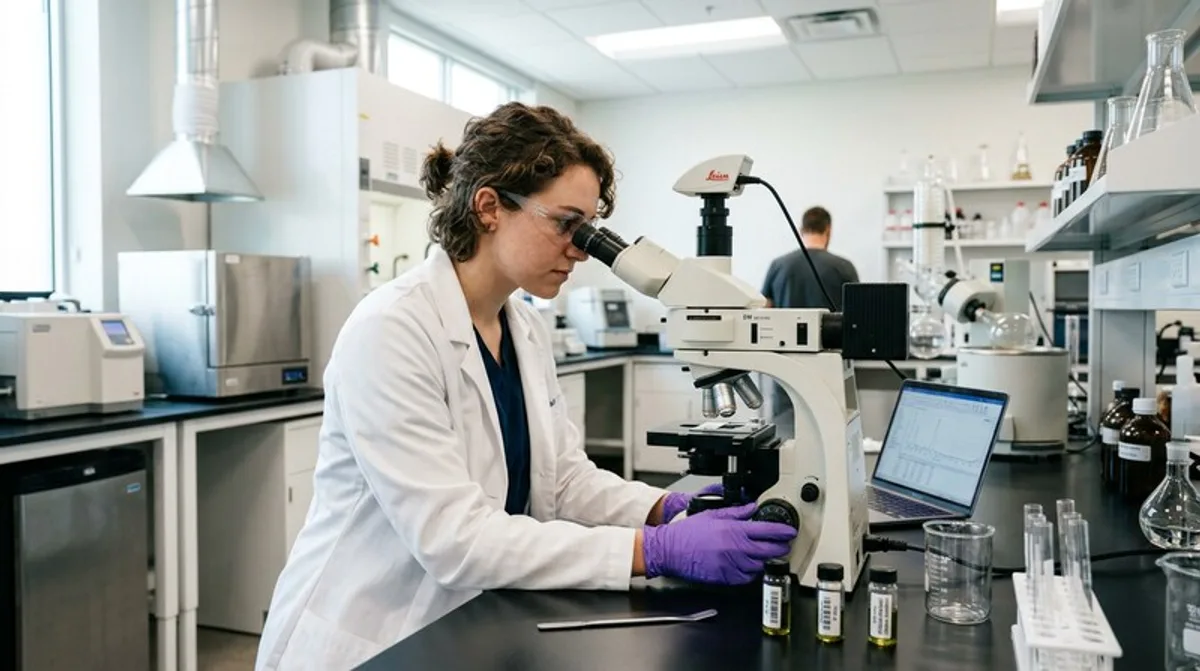
Step one is the immunoassay (IA) screen. This is a rapid antibody-based test performed on your urine specimen. It is designed for high throughput and low cost, not precision. It tests for the presence of drug metabolites above a defined cutoff concentration — for cannabis, this is 50 ng/mL of THC-COOH. The IA can produce false positives (certain foods, medications, and supplements can cross-react with cannabis antibodies) and is not sufficient by itself for an employment adverse action.
Step two is GC-MS confirmation. Any specimen that screens positive on IA is automatically forwarded to a certified laboratory for Gas Chromatography-Mass Spectrometry testing at a more sensitive cutoff (15 ng/mL for THC-COOH). GC-MS identifies the exact molecular fingerprint of THC-COOH, eliminating false positives. Only a GC-MS confirmed result is reported to the employer as “positive.”
State Pre-Employment Cannabis Protections
The legal landscape has shifted significantly since 2021. Multiple states have enacted legislation restricting employer use of pre-employment cannabis testing, particularly for non-safety-sensitive positions. The following table reflects enacted law and regulations as of early 2026 — not pending legislation.
| State | Protection Level | Key Restriction | Safety-Sensitive Exemption |
|---|---|---|---|
| California | Strong | Prohibits pre-employment testing for most jobs (AB 2188, 2024) | Yes — safety-sensitive roles exempt |
| New York | Strong | Bans pre-employment cannabis testing statewide | Yes — DOT, law enforcement exempt |
| New Jersey | Strong | Cannot refuse to hire solely for cannabis use/positive test | Yes — safety-sensitive roles |
| Minnesota | Strong | Pre-employment testing prohibited for most positions (2023) | Yes — federally regulated jobs |
| Connecticut | Moderate | Cannot test during application process before conditional offer | Yes — safety-sensitive |
| Washington DC | Moderate | Cannot fail candidate solely on cannabis test | Federal agencies exempt |
| Illinois | Limited | Cannot discriminate against off-duty cannabis use | Safety-sensitive exempt |
| Colorado | Limited | CROWN Act: some at-home use protections | Safety-sensitive exempt |
| Nevada | Moderate | Cannot refuse to hire based solely on positive cannabis test | Safety-sensitive exempt |
| Federal/DOT | None | Mandatory testing; state law irrelevant | N/A — all covered positions |
The 5-Panel Test: What Gets Screened
The standard pre-employment drug test screens five substance categories simultaneously. Understanding what each panel tests for — and common false positive sources — is important if you need to explain a result.
| Panel | Metabolite Tested | Urine Cutoff (IA) | GC-MS Cutoff | Common False Positive Sources |
|---|---|---|---|---|
| Cannabis | THC-COOH | 50 ng/mL | 15 ng/mL | Dronabinol (Marinol), hemp seed products (rare) |
| Cocaine | Benzoylecgonine | 150 ng/mL | 100 ng/mL | Coca tea (high concentration) |
| Amphetamines | Amphetamine/Meth | 500 ng/mL | 250 ng/mL | Pseudoephedrine, certain SSRIs (rare), Adderall (legitimate Rx) |
| Opiates | Morphine/Codeine | 2000 ng/mL | 2000 ng/mL | Poppy seeds (high dose), codeine cough medicines |
| PCP | Phencyclidine | 25 ng/mL | 25 ng/mL | Dextromethorphan (DXM) — rare at therapeutic doses |
Timeline of a Positive Result: What Happens Step by Step
Most candidates are unaware of the multi-step review process that occurs between specimen collection and employer notification. A Medical Review Officer (MRO) — a licensed physician with specialized training — is required to review all confirmed positive results under federal and most state guidelines before the employer is notified.
| Step | Action | Timeframe | Your Rights |
|---|---|---|---|
| 1 | Specimen collection at certified collection site | Day 0 | Right to witness split into two vials |
| 2 | IA screening at laboratory | Day 1–2 | N/A (you are not notified at this stage) |
| 3 | GC-MS confirmation (if IA positive) | Day 2–3 | N/A |
| 4 | MRO contacts you for explanation (medication, Rx) | Day 3–5 | Right to disclose legitimate prescriptions |
| 5 | MRO reports result to employer (positive or negative) | Day 5–7 | Right to request split specimen retest |
| 6 | Employer takes action (rescinds offer or proceeds) | Day 7–14 | State-specific appeal rights |
| 7 | Split specimen retest (if requested) | Additional 5–10 days | Request within 72 hours of MRO notification |
Industries With Stricter Pre-Employment Testing Requirements
State-level cannabis protections do not apply to industries regulated under federal law. The following industries face mandatory, standardized drug testing requirements regardless of where the employee works.
| Industry/Sector | Governing Regulation | Test Required | State Protections Apply? |
|---|---|---|---|
| Commercial trucking (CDL) | DOT 49 CFR Part 382 | Urine 5-panel pre-employment | No |
| Aviation (FAA regulated) | DOT 49 CFR Part 121 | Urine 5-panel pre-employment | No |
| Rail (FRA regulated) | DOT 49 CFR Part 219 | Urine 5-panel pre-employment | No |
| Federal employees | EO 12564 / SAMHSA Guidelines | Urine mandatory | No |
| Federal contractors | Drug-Free Workplace Act 1988 | Policy required; testing common | No |
| Healthcare (CMS regulated) | State & CMS standards | Varies by state & employer | Partial |
| Law enforcement | State/agency policy | Typically mandatory | Safety-sensitive exemption applies |
Medical Marijuana and Pre-Employment Testing
One of the most commonly misunderstood areas of cannabis employment law is the interaction between medical marijuana status and pre-employment testing. In most states, having a valid medical marijuana card does not protect you from a failed pre-employment drug test. The employer’s obligation — if any — is typically to engage in an “interactive process” to determine whether a reasonable accommodation is possible for an on-the-job policy, not to ignore a positive pre-employment screen.
States with the strongest medical marijuana employment protections include Connecticut, New York, New Jersey, Minnesota, and Arizona. Even in these states, positions classified as safety-sensitive are typically exempt from accommodation requirements.
If you work for or are applying to a federal agency, federal contractor in safety-sensitive roles, or DOT-regulated employer (truck driver, pilot, rail worker), no state cannabis law applies to your drug test. Cannabis remains a Schedule I controlled substance under federal law, and the Drug-Free Workplace Act imposes zero-tolerance requirements that state legalization cannot override.
Frequently Asked Questions
Can an employer rescind a job offer for a positive cannabis test?
In most states, yes. However, California, New York, New Jersey, Minnesota, and a growing number of states now restrict this practice for non-safety-sensitive roles. Always check the specific law in your state.
What does the 5-panel pre-employment test check for?
Cannabis (THC-COOH), cocaine (benzoylecgonine), amphetamines, opiates, and phencyclidine (PCP). Immunoassay screen first; GC-MS confirmation for any positive result.
Can I retest after a positive pre-employment drug result?
You can request retesting of the original split specimen through a certified HHS laboratory. This must be requested within 72 hours of MRO notification. The retest fee is typically your responsibility unless the result is negative.