








- Hydroponic cannabis grows 30–50% faster than soil cultivation, enabling more grow cycles per year and significantly higher annual yields in the same space.
- Indoor hydro cannabis yields are consistently 15–25% higher per square metre than comparable soil grows due to direct, uninterrupted nutrient delivery to the root zone.
- pH must be maintained between 5.5–6.5 in hydroponic systems — even minor drift outside this range causes nutrient lockout and visible deficiency symptoms within 48–72 hours.
- EC (electrical conductivity) and PPM (parts per million) must be matched to the growth stage: 200–400 PPM at seedling rising to 1,200–1,800 PPM at peak flower.
- Water temperature must stay below 68°F (20°C) at all times — above this threshold dissolved oxygen drops and Pythium (root rot) risk increases sharply.
- Recirculating hydroponic systems use up to 90% less water than soil cultivation, making them among the most resource-efficient growing methods available.
- Deep Water Culture (DWC) is the most popular hydroponic method among home cannabis growers, accounting for an estimated 40% of hobby hydro setups globally.
Hydroponic Systems for Cannabis: Five Methods Compared
Hydroponics is the practice of growing plants in a nutrient solution rather than soil, with the roots suspended in, flooded by, or misted with that solution. For cannabis, this approach delivers dramatic advantages: roots access nutrients directly and continuously, growth rates accelerate significantly, and the absence of soil eliminates an entire category of pest and pathogen risk. The trade-off is that hydroponic systems require more active management, particularly pH and nutrient concentration monitoring, and errors propagate faster than in buffered soil environments.
Five main hydroponic systems are used for cannabis cultivation at home and commercial scale. Each has a distinct mechanism, maintenance profile, and optimal use case. Understanding the differences before committing to a system is one of the most valuable planning steps a new hydro grower can take.
| System | Setup Cost | Maintenance | Yield Potential | Difficulty | Best For |
|---|---|---|---|---|---|
| DWC (Deep Water Culture) | $50–$200 | Medium | High | Beginner–Intermediate | First hydro grow, single plants |
| RDWC (Recirculating DWC) | $200–$600 | Medium–High | Very High | Intermediate | Multi-plant grows, commercial |
| NFT (Nutrient Film Technique) | $150–$400 | High | High | Intermediate–Advanced | Experienced growers, high turnover |
| Ebb-and-Flow (Flood and Drain) | $100–$300 | Medium | High | Intermediate | Multi-media grows, versatile |
| Aeroponics | $300–$1,000+ | Very High | Highest | Advanced | Maximum yield, experienced only |
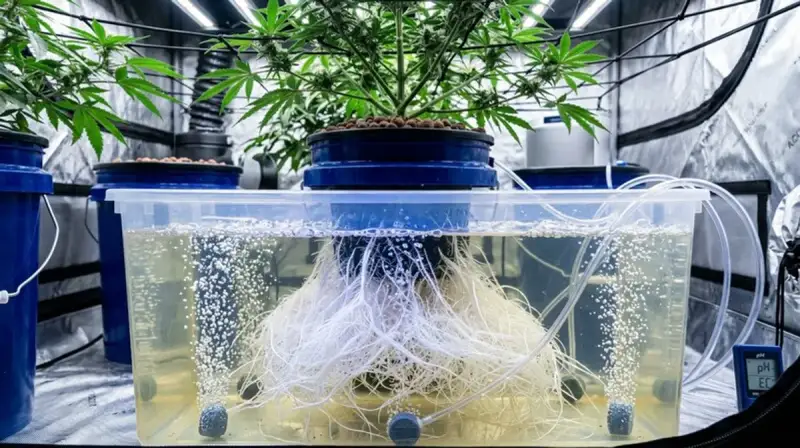
DWC suspends roots in an aerated nutrient solution inside a sealed reservoir. An air pump drives one or more air stones that maintain dissolved oxygen levels. Plants sit in net pots above the reservoir with roots dangling directly into the solution. DWC is the clearest choice for first-time hydro growers because the system is simple, transparent, and forgiving of minor errors compared to systems with more moving parts.
RDWC connects multiple individual DWC buckets to a central reservoir via a recirculating pump. This allows one central reservoir to supply and monitor all plants simultaneously, making pH and EC management more consistent across a multi-plant canopy. RDWC is the professional standard for mid-scale indoor cannabis production.
NFT channels a thin film of nutrient solution across the bottom of angled troughs, past plant root systems, and back to a reservoir. The roots sit partly in solution and partly in open air, maximising oxygen exposure. NFT requires very precise flow rate management — too little flow dries the roots, too much floods them — making it less forgiving than DWC but capable of excellent yields when dialled in.
Ebb-and-Flow periodically floods a growing tray with nutrient solution and then drains it back to a reservoir on a timer. The cycles of flooding and draining deliver nutrients and oxygen in alternating pulses. This system is highly compatible with a variety of growing media (coco coir, clay pebbles, rockwool) and is popular with growers who want to transition gradually from soil to a more active hydroponic approach.
Aeroponics suspends roots in open air inside a sealed chamber and delivers nutrients by misting every few seconds or minutes. Roots have near-maximum oxygen exposure at all times, producing the fastest growth rates of any hydroponic method. The complexity of maintaining the misting system without blockages or failures makes aeroponics the domain of experienced growers who are prepared for the maintenance demands. For growers new to cannabis cultivation in general, starting with DWC and progressing to RDWC after one successful cycle is the most common and effective learning path.
pH Management: The Critical Variable in Hydroponics
pH management is the single most important active maintenance task in any hydroponic cannabis system — more important than nutrient concentration, more important than light schedule, and responsible for more failed hydro grows than any other controllable variable. Cannabis in soil can tolerate pH drift because the soil matrix buffers fluctuations naturally through cation exchange. Hydroponic systems have no such buffer. The nutrient solution is the entire growing environment and its pH directly determines which nutrients are chemically available for root uptake at any given moment.
The target pH range for hydroponic cannabis is 5.5–6.5. Within this range, all major and secondary nutrients are available for uptake. Below 5.5, manganese and iron become excessively available and calcium and magnesium absorption is blocked, producing toxicity symptoms. Above 6.5, iron, manganese, and zinc become less available, producing deficiency symptoms even when those nutrients are present in the solution at correct concentrations. The ideal sweet spot for most complete hydroponic nutrient formulas is 5.8–6.2.
Test pH at least once every 24 hours using a calibrated digital pH meter (pH test strips are not sufficiently accurate for hydroponic management). Adjust with commercially available pH Up (potassium hydroxide solution) and pH Down (phosphoric or citric acid solution). Add adjusters drop by drop and allow the solution to mix thoroughly before re-testing — over-adjustment is a common beginner error that causes the pH to swing past the target in the opposite direction.
In contrast, soil-grown cannabis targets a pH of 6.0–7.0. Growers switching from soil to hydroponics must recalibrate their expectations significantly — a pH of 7.0 that would be acceptable in rich soil will lock out iron and zinc completely in a hydro system. This is one of the most common causes of apparent nutrient deficiency in growers who transition between growing media without adjusting their pH targets accordingly.
EC, PPM, and Nutrient Management by Growth Stage
EC (electrical conductivity) and PPM (parts per million) are two measurements of the same thing: the concentration of dissolved minerals in your nutrient solution. EC is the international standard (measured in mS/cm); PPM is a derived unit used widely in North American growing culture (500 scale or 700 scale, depending on the conversion factor used). Most modern nutrient meter displays show both.
Getting EC and PPM right at each stage of the grow is the difference between explosive growth and the visual feast of deficiency symptoms that frustrate most new hydro growers. Cannabis has a dramatically different appetite at different life stages — a seedling overwhelmed by the concentration appropriate for a flowering plant will experience nutrient burn severe enough to stunt or kill it. Conversely, a heavily flowering plant running on seedling-level concentrations will struggle to build buds and show characteristic deficiencies.
| Stage | EC (mS/cm) | PPM (500 scale) | Notes |
|---|---|---|---|
| Seedling (week 1–2) | 0.4–0.8 | 200–400 | Plain water or very weak seedling formula only |
| Early Veg (week 2–4) | 0.8–1.2 | 400–600 | Introduce full veg nutrient formula at quarter strength |
| Late Veg (week 4–6) | 1.6–2.0 | 800–1,200 | Full veg strength; increase gradually, watch leaf tips |
| Early Flower (week 1–3) | 2.0–2.4 | 1,000–1,200 | Transition to bloom formula; reduce nitrogen |
| Peak Flower (week 4–8) | 2.4–3.0 | 1,200–1,800 | Full bloom formula; monitor runoff EC |
| Late Flower / Flush (final 1–2 weeks) | 0.0–0.4 | 0–200 | Plain pH-adjusted water or plain flush |
Always adjust EC and PPM gradually — never jump from seedling concentrations to full veg strength in one reservoir change. Increase by 0.2–0.4 EC per week maximum during the transition from seedling to veg, and monitor the leaves closely at each change. The first visible sign of over-concentration is slight claw-curl or brown tips at the leaf margins — if you see these, dilute the reservoir immediately and re-measure.
Oxygen, Water Temperature, and Reservoir Maintenance
Dissolved oxygen (DO) in the nutrient solution is the life support system for hydroponic cannabis roots. Unlike soil organisms that create air pockets, hydroponic roots receive oxygen entirely from dissolved gas in the water. If dissolved oxygen falls, root metabolism slows, nutrient uptake drops, and the anaerobic conditions that allow root rot pathogens like Pythium to establish are created. The primary tools for maintaining adequate dissolved oxygen are air pumps, air stones, and water temperature control.
Cold water holds more dissolved oxygen than warm water — this is a fundamental physical property with critical practical implications for hydroponic growers. At 65°F (18°C), water holds approximately 9.1 mg/L dissolved oxygen. At 75°F (24°C), that figure drops to 8.3 mg/L. At 80°F (27°C), it falls further to 7.7 mg/L, and root rot risk increases sharply as Pythium thrives in warm, low-oxygen water. The maximum safe reservoir temperature is 68°F (20°C); the ideal target is 63–65°F (17–18°C). Water chillers are a standard piece of equipment in serious indoor hydro setups.
Tap water in most municipal water systems contains chloramine — a more stable disinfectant than chlorine that does not off-gas overnight like chlorine does and cannot be removed by simply leaving water to sit. Chloramine damages beneficial bacteria and can stress cannabis roots directly. Use a chloramine-specific filter or water conditioner (such as sodium thiosulfate) when filling reservoirs with tap water, or use reverse osmosis (RO) water as the basis for your nutrient solution.
Common Hydroponic Problems: Causes and Fixes
| Problem | Primary Cause | Fix |
|---|---|---|
| Root rot (brown, slimy roots) | Water temp >68°F; low DO; light leak into reservoir | Chill water to <65°F; add Hydroguard or SB-1; seal all light gaps; increase air stone output |
| Nutrient lockout (deficiency symptoms despite correct EC) | pH outside 5.5–6.5 range | Flush reservoir; remix with correct pH; recalibrate pH meter |
| Rapid pH drift (rises or drops within 12 hours) | Root rot consuming nutrients; high EC; aggressive plant uptake | Address root rot; reduce EC; use pH buffers in formula |
| Algae in reservoir (green water, green roots) | Light reaching reservoir or exposed water surfaces | Cover all reservoir surfaces; use opaque tubing; add UV steriliser |
| Nutrient deficiency despite correct formula | Antagonism between nutrients at high EC; pH drift | Flush system; reduce to 75% EC; verify pH before re-evaluating formula |
| Stunted growth despite correct pH and EC | Insufficient dissolved oxygen; root zone temperature | Add second air stone; verify water temp <68°F; check pump output |
Hydroponic cannabis rewards growers who establish consistent daily monitoring routines. A five-minute daily check — pH reading, EC reading, water level top-off, and a quick visual inspection of roots through the reservoir inspection port — catches the vast majority of problems before they become irreversible. Most hydro failures are not caused by the system being inherently difficult; they result from infrequent monitoring that allows small, easily corrected drift to compound over several days into a full nutrient lockout or pathogen outbreak. For growers who want to select the right cannabis genetics for their hydro system, high-yielding indoor-optimised strains from our cannabis strain guide include notes on hydroponic performance and nutrient sensitivity.