





Reviewed by the ZenWeedGuide Policy Team — laws verified May 2026
- Cannabis Regulation Act (SB 2) signed June 29, 2021; retail sales launched April 2022
- Age requirement: 21+ for recreational purchase, possession, and gifting
- Public possession: 2 oz flower, 16 g concentrate, 800 mg edibles
- Home cultivation: up to 6 plants per adult, maximum 12 plants per household
- Excise tax: 12%, rising 1% annually to 18% by 2030
- Cannabis Control Division (CCD) oversees licensing and enforcement
- Medical program active since 2007; parallel track with separate limits and tax treatment
- Navajo Nation and other tribal lands operate under separate sovereign cannabis rules
New Mexico Cannabis: Quick Reference
| Category | Rule |
|---|---|
| Recreational legal status | Legal — retail sales since April 2022 |
| Minimum purchase age | 21+ |
| Public possession (flower) | 2 oz (56 g) |
| Public possession (concentrate) | 16 g |
| Public possession (edibles) | 800 mg THC |
| Home cultivation | 6 plants per adult, 12 max per household |
| Gifting | Up to 2 oz between adults 21+ |
| Excise tax (current) | 12% (rising to 18% by 2030) |
| Public consumption | Prohibited; civil fine $50 |
| Medical program | Active since 2007 |
| Regulator | Cannabis Control Division (CCD) |
Legislative History
Governor Michelle Lujan Grisham signed the Cannabis Regulation Act (Senate Bill 2) into law on June 29, 2021, making New Mexico the 17th US state to legalize adult-use cannabis. The bill passed the New Mexico House 36–34 and the Senate 22–15, reflecting significant bipartisan resistance alongside majority support. Retail sales to adults 21 and older launched on April 1, 2022 — a date chosen for market symbolism.
The Cannabis Regulation Act created the Cannabis Control Division (CCD) within the Regulation and Licensing Department to oversee every aspect of the market, from cultivator licensing to retail compliance and consumer protection. The CCD also administers the social equity licensing framework, which provides reduced fees and priority review for applicants from communities disproportionately affected by prior cannabis enforcement.
New Mexico’s market has grown rapidly. Over 550 licensed retail locations now operate statewide, including significant rural coverage in a state where most other regulated industries concentrate in Albuquerque, Santa Fe, and Las Cruces. Social equity micro-licenses lowered barriers for small-scale operators entering the market alongside larger multi-state operators.
Possession Limits in Detail
New Mexico sets distinct possession caps for each cannabis product category, making its framework one of the most precisely defined in the Southwest. Adults 21 and older may possess the following in public:
| Product Category | Public Possession Limit | Purchase Limit Per Visit |
|---|---|---|
| Cannabis flower | 2 oz (56 g) | 2 oz |
| Cannabis concentrate / extract | 16 g | 16 g |
| Edible products | 800 mg THC | 800 mg THC |
| Combination products | Equivalent to 2 oz flower | Per dispensary policy |
At home, adults may store larger quantities provided the amounts relate to personal use, permitted gifting, or home cultivation harvest. Possession at the lower end of criminal thresholds will still likely receive civil treatment under prosecutorial discretion guidelines issued by the CCD.
Home Cultivation Rules
New Mexico offers one of the more generous home cultivation allowances in the US. The 6-per-adult framework applies to plants at any stage of growth, meaning there is no separate cap on seedlings vs. mature plants within a single adult’s allocation:
| Rule | Detail |
|---|---|
| Plants per adult (any stage) | 6 |
| Maximum per household | 12 plants total |
| Visibility restriction | Not visible from any public place |
| Security requirement | Secured from access by minors |
| State registration required | No registration needed for personal grows |
| Caregiver grows | Caregivers for medical patients may grow additional plants per patient |
| Gifting home-grown product | Permitted within the 2 oz gifting limit between adults 21+ |
Dispensary and Purchase Rules
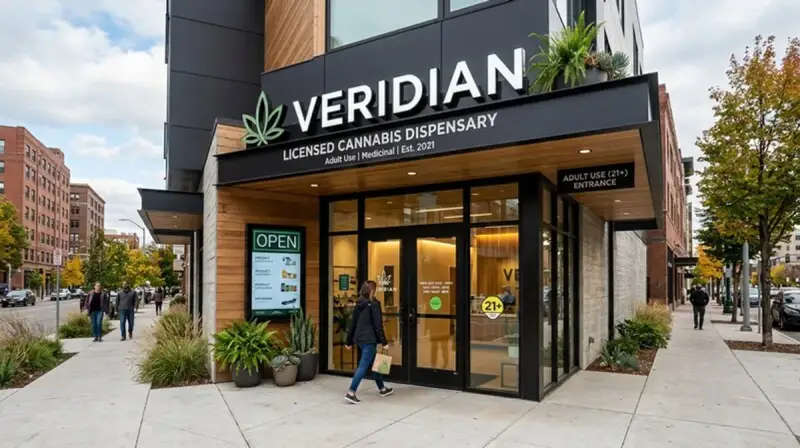
Licensed cannabis retailers in New Mexico must verify age at every transaction. Valid government-issued photo ID is required. There is no residency requirement: out-of-state visitors 21 and older may purchase at any licensed dispensary. Daily purchase limits mirror public possession caps per transaction. Many dispensaries offer online ordering with in-store pickup, and delivery to private residences is permitted for licensed retailers who obtain delivery authorization from the CCD.
Dispensaries cluster heavily in Albuquerque, Santa Fe, and along the I-25 corridor. Bernalillo County (Albuquerque) has the highest dispensary density in the state, while rural eastern counties along the Texas border have fewer licensed retailers due to enforcement culture differences and proximity to Texas’s prohibition regime.
Tax Structure
New Mexico applies a graduated cannabis excise tax designed to start competitively low and scale up as the legal market displaces illicit supply. The schedule is fixed in statute:
| Year | Cannabis Excise Tax Rate |
|---|---|
| 2022 | 12% |
| 2023 | 13% |
| 2024 | 14% |
| 2025 | 15% |
| 2026 | 16% |
| 2027 | 17% |
| 2028 and beyond | 18% (statutory cap) |
In addition to the cannabis excise tax, the state’s standard gross receipts tax applies to retail cannabis transactions. Gross receipts tax rates vary by municipality, ranging from approximately 5% in rural areas to over 9% in Albuquerque. Combined state and local effective rates in Albuquerque can approach 25% at the register. Medical cannabis products are exempt from the excise tax, giving registered patients a meaningful cost advantage.
Driving Under the Influence of Cannabis
Driving under the influence of cannabis is a criminal offense under New Mexico Statute 66-8-102. Unlike Colorado and Washington, New Mexico has no per se THC blood-level threshold. Law enforcement relies on observed impairment, standardized field sobriety testing, and Drug Recognition Evaluator (DRE) assessments to establish impairment. A first DUI conviction carries a mandatory minimum 24-hour jail term or equivalent community service, substantial fines, ignition interlock requirements, and license revocation.
Cannabis in a vehicle must be stored in a sealed, closed container or placed in the trunk to avoid additional open-container charges. An open container of cannabis in the passenger compartment of a moving vehicle is a separate civil infraction regardless of whether the driver is impaired.
Employment and Housing Rights
The Cannabis Regulation Act includes employment protections for lawful off-duty cannabis use. Employers may not take adverse action — termination, demotion, or refusal to hire — against an employee or applicant solely because of lawful off-duty cannabis use or a positive cannabis drug test when the employee does not arrive impaired. However, the law preserves employer rights to prohibit on-duty impairment and to maintain drug-free workplace programs for safety-sensitive roles and positions subject to federal regulations, including CDL drivers, aviation workers, and federal contractors.
Landlords may prohibit cannabis smoking on their properties and within rental units, even when adults are legally permitted to possess cannabis. Federally subsidized housing continues to apply federal cannabis prohibitions. Workers’ compensation claims based on injuries sustained while impaired by cannabis may be denied depending on the circumstances and the employer’s workplace policy.
Expungement of Prior Convictions
The Cannabis Regulation Act mandated automatic expungement for prior simple possession convictions involving amounts now legal under the Act. New Mexico courts are required to process eligible records without requiring petitions from affected individuals. This covers tens of thousands of New Mexicans with records for conduct that is now entirely lawful. Convictions for distribution, possession with intent to distribute, or amounts significantly above the personal-use threshold are not automatically expunged and require a separate judicial petition.
Local Jurisdiction Opt-Out Provisions
The Cannabis Regulation Act does not allow municipalities or counties to ban cannabis retail operations outright, but local governments retain zoning authority to regulate where dispensaries may operate, including distance requirements from schools, daycares, and places of worship. Several rural counties along the Texas and Oklahoma borders have used aggressive zoning to effectively limit retail access within their boundaries while stopping short of an outright ban.
Medical Cannabis Program
New Mexico established its medical cannabis program in 2007 under the Lynn and Erin Compassionate Use Act, making it one of the earlier western states to legalize medical cannabis. The program predates recreational legalization by 15 years and has a well-established patient base and licensed producer network. Qualifying conditions include cancer, epilepsy, multiple sclerosis, PTSD, Crohn’s disease, Parkinson’s disease, HIV/AIDS, ALS, spinal cord damage, chronic pain, and other debilitating conditions approved by the New Mexico Department of Health. Medical patients receive higher possession limits, tax exemptions on cannabis purchases, access to higher-potency products, and caregiver support.
Tribal Sovereignty and Navajo Nation Rules
New Mexico contains 23 federally recognized Native American pueblos, nations, and tribes. The largest is the Navajo Nation, which spans portions of New Mexico, Arizona, and Utah. Tribal lands operate under sovereign jurisdiction: state cannabis law does not automatically apply. The Navajo Nation has its own government and its own cannabis policy framework, which may differ significantly from New Mexico state law.
Some smaller pueblos in northern New Mexico have authorized licensed cannabis sales on tribal land as an economic development tool, operating dispensaries that attract New Mexico residents and tourists. Others maintain prohibition consistent with tribal traditional values. Travelers must verify the current cannabis policy of any specific tribal nation before possessing or purchasing cannabis on tribal land. Bringing state-legal cannabis onto a tribal land that prohibits it may violate tribal law and result in confiscation or other tribal law enforcement action.
Interstate Transportation Rules
Cannabis purchased legally in New Mexico must remain in New Mexico. Transporting cannabis across any state line — into Colorado, Arizona, Texas, or Oklahoma — is a federal offense under the Controlled Substances Act regardless of New Mexico law. Federal highways including I-25, I-40, and US-550 are subject to federal jurisdiction. Cannabis purchased in New Mexico may not be taken to Carlsbad Caverns National Park, White Sands National Park, or any other federal land, even within state borders.
Crossing any state or federal boundary with cannabis is a federal offense. This applies even between two states where cannabis is legal. Federal property, national parks, and military installations within New Mexico enforce federal law regardless of state statute.
Penalty Reference Table
| Violation | Classification | Potential Penalty |
|---|---|---|
| Public consumption | Civil infraction | $50 fine |
| Possession over limit (minor overage) | Civil infraction | Fine; no criminal record |
| Possession over limit (large amount) | Misdemeanor or felony | Fines; possible imprisonment |
| Distribution without license | Felony | Significant fines and imprisonment |
| Providing cannabis to minors | Felony (enhanced) | Prison time; mandatory minimum |
| Cannabis DUI | Criminal misdemeanor / felony | Jail, fines, license revocation |
| Possession on federal property | Federal misdemeanor or felony | Federal prosecution applies |
| Interstate transport | Federal felony | Federal criminal prosecution |
Frequently Asked Questions
Can tourists buy cannabis in New Mexico?
Yes. New Mexico imposes no residency requirement. Any adult 21 or older with valid government-issued photo ID may purchase up to the transaction limits at any licensed dispensary. Bringing cannabis across any state line remains a federal offense regardless of the destination state’s laws.
Are there cannabis consumption lounges in New Mexico?
The Cannabis Regulation Act authorized social consumption lounges, but as of May 2026 the Cannabis Control Division had not finalized lounge licensing rules. Consumption remains limited to private property. Monitor the CCD’s website for updates on lounge permit availability.
Does New Mexico allow cannabis delivery?
Yes. Licensed cannabis retailers may offer delivery to private residences in New Mexico. Drivers must verify age at the point of delivery. Not all retailers offer delivery; coverage is stronger in Albuquerque and Santa Fe than in rural areas.
How is cannabis gifting regulated?
Adults 21 and older may give up to 2 ounces of cannabis to another adult 21 or older at no charge. The gift cannot be tied to a commercial transaction. So-called pay-to-gift arrangements — where cannabis is given in exchange for purchasing another product — are treated as unlicensed sales and carry the same criminal penalties.
Does the Bernalillo County enforcement culture differ from rural New Mexico?
Albuquerque and Bernalillo County have generally aligned enforcement with the spirit of legalization, treating minor civil infractions accordingly. Some rural eastern and southern New Mexico counties, particularly those bordering Texas, historically had higher arrest rates for cannabis and may apply civil fine structures more aggressively for infractions within their jurisdiction.
What is the process for expunging an old possession conviction?
Automatic expungement applies to most prior simple possession convictions for amounts now legal. Courts process these without individual petitions. For convictions outside the automatic category — such as possession with intent or larger amounts — individuals must file a petition with the district court where the conviction occurred. Consulting a New Mexico criminal defense attorney familiar with the expungement provisions is recommended for complex cases.