








- Issue 2 passed November 2023 (57% in favor); possession legal December 2023; retail sales began August 2024
- Adults 21+ may possess up to 2.5 oz flower and 15g concentrate in public
- Home cultivation: 6 plants per adult, maximum of 12 plants per residence
- 10% recreational excise tax applies at the point of sale at licensed dispensaries
- Medical cannabis program active since 2016 (HB 523) with broad qualifying conditions
- Employer drug testing rights explicitly preserved — no off-duty consumption protection
- DUI cannabis law includes 2ng/mL active THC per se limit in blood
Ohio Cannabis Quick-Reference Table
| Category | Rule |
|---|---|
| Legal Status | Recreational and Medical |
| Minimum Age | 21+ (recreational) / 18+ with card (medical) |
| Public Possession — Flower | 2.5 oz (70g) |
| Public Possession — Concentrate | 15g |
| Home Cultivation | 6 plants per adult (max 12 per residence) |
| Daily Purchase Limit (Flower) | 1 oz per transaction |
| Recreational Excise Tax | 10% |
| Regulator | Division of Cannabis Control (DCC) |
| Issue 2 Passed | November 2023 (~57% in favor) |
| Possession Legal | December 2023 |
| Retail Sales Launch | August 2024 |
| Medical Program | Since 2016 (HB 523) |
Issue 2: Ohio’s Path to Legalization
Issue 2 appeared on the November 2023 ballot as a constitutional amendment, a stronger vehicle for cannabis legalization than statutory legislation that could be reversed by future legislatures without another ballot measure. Ohio voters approved it by approximately 57% — a comfortable margin in a state that had voted Republican in the preceding presidential elections, demonstrating the cross-partisan appeal of cannabis reform.
The constitutional amendment took effect immediately upon certification in December 2023, legalizing adult possession. However, establishing licensed retail required the Division of Cannabis Control to develop regulations, issue licenses, and build out compliance infrastructure. That process concluded with retail sales launching in August 2024, approximately eight months after possession became legal.
Ohio’s path was not without complications. The legislature passed HB 86 in response to Issue 2, implementing the voter-approved framework while also setting purchase limits and establishing the regulatory structure. Some provisions drew criticism from cannabis reform advocates, but the core legalization framework remained intact.
Possession and Purchase Limits in Detail
Ohio’s possession limits distinguish between public and home possession, and between flower and concentrate. Understanding these distinctions matters for compliance:
- Public possession (flower): Up to 2.5 ounces (approximately 70 grams)
- Public possession (concentrate): Up to 15 grams
- Home possession: The 2.5 oz limit applies at home as well for purchased product
- Edibles and infused products: Covered under separate THC milligram limits per item and per package
- Daily dispensary purchase: 1 oz of flower or equivalent per day per adult
Exceeding these limits enters criminal territory that scales with the amount over the limit. The differential between the daily purchase limit (1 oz at dispensary) and the possession limit (2.5 oz) means consumers can accumulate product over time within the possession ceiling.
Home Cultivation: Ohio’s Rules
Ohio’s Issue 2 explicitly created a home cultivation right for adults 21 and older. The rules are relatively clear but the per-residence cap creates practical constraints for households with multiple adults:
- Each adult 21+ may cultivate up to 6 plants (combination of flowering and vegetative)
- The maximum per residence is 12 plants regardless of how many adults live there
- Plants must be in a locked, secured space not visible from any public space
- No registration with the state is required for home cultivation
- Selling or transferring home-grown cannabis to others without a license is a felony
- Renters should check lease terms — landlords may prohibit home cultivation and cannabis use on the property
| Scenario | Home Grow Limit |
|---|---|
| Single adult household | 6 plants maximum |
| Two adults (21+) in one residence | 12 plants maximum |
| Three or more adults in one residence | 12 plants maximum (per-residence cap) |
| Must be visible from public space? | No — must be out of public view |
| Must be locked/secured? | Yes |
Ohio Medical Cannabis Program
Ohio’s medical cannabis program was established by House Bill 523 in 2016 and has operated continuously since. It predates Issue 2 by seven years and serves patients with a wide range of qualifying conditions including chronic pain, PTSD, cancer, epilepsy, multiple sclerosis, Crohn’s disease, Parkinson’s disease, and Alzheimer’s disease among others.
Medical patients benefit from the program in several concrete ways even after recreational legalization:
| Benefit | Medical Patient | Recreational Adult-Use |
|---|---|---|
| Age requirement | 18+ (with physician certification) | 21+ |
| Possession limit | 90-day supply as certified | 2.5 oz flower / 15g concentrate |
| Home cultivation | Not permitted under medical-only | 6 plants per adult (12 max) |
| Tax rate | Reduced (medical exemption) | 10% excise + local taxes |
| Product access | Higher potency products permitted | Standard adult-use products |
| Under 21 access | Yes with parental consent and physician certification | No |
Tax Structure and Revenue
Ohio’s 10% recreational excise tax is relatively modest compared to states like Washington (37%) or California (15% + local). Local municipalities may add additional sales taxes on cannabis purchases. Revenue from the excise tax is distributed across several funds including substance abuse treatment, law enforcement, municipalities hosting dispensaries, and administrative costs.
Ohio’s relatively low tax rate was intentional — policymakers sought to make licensed dispensaries competitive with the existing illegal market, which had been substantial in the state. A high tax rate can price legal product out of reach and inadvertently sustain illegal market activity.
Ohio vs. Neighboring States
| State | Status | Key Difference |
|---|---|---|
| Ohio | Recreational Legal | Issue 2 (2023); 10% tax; 2.5oz limit |
| Michigan | Recreational Legal | Proposal 1 (2018); 2.5oz public; 12 plants |
| Illinois | Recreational Legal | HB 1438 (2019); 30g flower; 5 plants |
| Indiana | Fully Illegal | No medical program; all possession criminal |
| Kentucky | Medical Only | SB 47 (2023); medical launched 2025 |
| West Virginia | Medical Only | Limited medical program; no recreational path |
| Pennsylvania | Medical Only | Active medical program; recreational repeatedly stalled |
Ohio Dispensaries: Columbus, Cleveland, Cincinnati
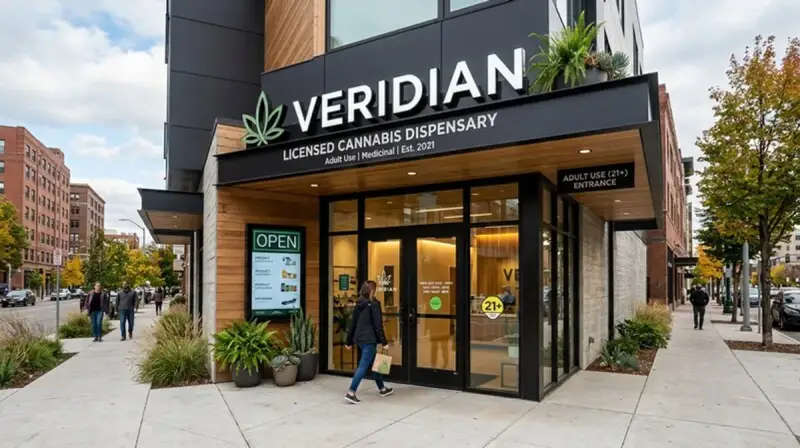
Ohio entered the recreational market with an existing network of medical dispensaries that were licensed to begin adult-use sales. Columbus has the largest concentration of licensed dispensaries and functions as the primary hub given its population size and central location. Cleveland, Cincinnati, Dayton, Akron, and Toledo all have growing retail footprints.
The Division of Cannabis Control maintains a public registry of licensed dispensaries. Online ordering and curbside pickup are widely available. Most Ohio dispensaries offer digital menus updated daily showing current inventory, pricing, and THC content. New licenses continue to be issued, gradually expanding geographic coverage in rural and suburban areas of the state.
Employer Rights and DUI Cannabis
Ohio’s Issue 2 explicitly preserved employer drug testing rights. This is a stronger employer-protective provision than exists in some recreational states like New Jersey, Connecticut, or Minnesota, which provide varying degrees of protection for off-duty cannabis use. Ohio employers may test, discipline, and terminate employees for positive cannabis drug tests regardless of whether the consumption occurred off-duty on private property.
Ohio DUI law covers cannabis impairment. A blood THC concentration at or above 2 nanograms per milliliter of active delta-9-THC creates a per se DUI presumption. This standard is contested by defense attorneys because blood THC levels do not reliably correlate with impairment, particularly in regular users who may have detectable levels days after consuming. Law enforcement also uses standardized field sobriety tests and Drug Recognition Expert evaluations.
Cannabis Penalties in Ohio
| Offense | Classification | Penalty |
|---|---|---|
| Possession 2.5–4 oz | Minor misdemeanor | Fine up to $150 |
| Possession 4 oz to 8 oz | Misdemeanor 2 | Up to 90 days jail + fine |
| Possession 8 oz to 1 lb | Felony 5 | 6–12 months prison + fine |
| Possession 1 lb to 20 lbs | Felony 3 | 9–36 months prison + fine |
| Possession over 20 lbs | Felony 2 | 2–8 years prison + fine |
| Unlicensed sale / trafficking | Felony (various) | Scales with quantity |
| Public consumption | Minor misdemeanor | Fine up to $150 |
| Underage possession (under 21) | Misdemeanor | Fine; possible diversion program |
Expungement Provisions
Issue 2 included provisions intended to address prior cannabis convictions for conduct now legal under the adult-use framework. The expungement process requires individual petitions through Ohio courts and eligibility is determined case by case. Individuals with prior cannabis convictions should consult an Ohio-licensed attorney to assess whether their specific record qualifies and to navigate the procedural requirements.
Ohio also has broader sealing and expungement statutes that may apply to certain drug convictions. The Division of Cannabis Control does not process expungements directly — the process runs through the court system in the county where the conviction occurred.
Frequently Asked Questions: Ohio Cannabis
Is cannabis legal in Ohio?
Yes. Issue 2 passed in November 2023 and made Ohio a recreational adult-use state. Personal possession became legal in December 2023. Licensed retail sales began in August 2024. Both recreational and medical programs now operate simultaneously.
How much cannabis can you possess in Ohio?
Adults 21+ may possess up to 2.5 ounces (70g) of cannabis flower and up to 15 grams of concentrate. Medical patients with a certified 90-day supply may possess more under their medical program allowance.
Can you grow cannabis at home in Ohio?
Yes. Adults 21+ may grow up to 6 plants per person at home with a maximum of 12 plants per household. Plants must be in a secure location not visible from a public space. No state registration is required for home cultivation.
Can Ohio employers still fire you for cannabis use?
Yes. Ohio’s Issue 2 explicitly preserved employer drug testing rights. Employers can test for cannabis and discipline or terminate employees for positive tests, including for off-duty consumption. Ohio provides no employment protection for recreational cannabis users.