







- Proposal 1 — November 2018: Passed with 56% of the vote, making Michigan the first Midwest state to legalize recreational cannabis. Licensed retail sales opened December 1, 2019.
- Public possession: 2.5 oz (70.9 g) of flower. At home: up to 10 oz. The 2.5 oz public limit is higher than Washington or California’s 1 oz standard.
- Home grow: Up to 12 plants per adult at a private residence, in an enclosed locked space out of public view. One of the most generous home grow allowances among legal states.
- Tax structure: 10% excise tax + 6% state sales tax = effective ~16% combined. Medical patients are exempt from the excise tax, paying only 6% sales tax.
- Largest Midwest market: Michigan surpassed Illinois in total recreational cannabis sales volume in 2022 and has maintained its position as the Midwest’s leading cannabis market, with 700+ active MRA-licensed retail locations.
- Municipal opt-out: Approximately 350 municipalities in Michigan have opted out of allowing recreational cannabis retail within their jurisdictions, creating geographic access disparities.
- Delivery legal: Licensed retailers may deliver to consumers with an MRA delivery endorsement; home delivery widely available in Detroit, Grand Rapids, Lansing and other major markets.
Quick Legal Reference — Michigan
| Category | Rule / Limit |
|---|---|
| Public possession — flower | 2.5 oz (70.9 g) |
| Public possession — concentrate | Included within 2.5 oz equivalent |
| At-home possession — flower | Up to 10 oz |
| At-home possession — homegrown | Not counted against 10 oz home limit |
| Recreational home grow | Up to 12 plants per adult; household max 12; enclosed, locked space |
| Medical home grow (MMMA) | Up to 12 plants per patient; caregiver may grow for up to 5 patients |
| Purchase age | 21+ recreational; 18+ (or any age) with MMMA card |
| State excise tax | 10% |
| State sales tax | 6% |
| Combined effective tax rate | ~16% (recreational); 6% (medical card) |
| Public consumption | Illegal; civil infraction, $100 fine |
| DUI | Impairment-based; no per se blood-THC threshold in Michigan |
| Delivery | Legal with MRA delivery endorsement |
| Licensed recreational retailers | 700+ statewide |
| Municipal opt-outs | ~350 municipalities (no retail sales in those jurisdictions) |
Home Cultivation Rules in Michigan
Michigan’s Recreational Marihuana Act (MRTMA) allows adults 21 and older to grow up to 12 cannabis plants at their private residence. This is one of the highest plant limits among any US state that has legalized home cultivation — most legal states cap home grows at 3–6 plants. The 12-plant limit is per adult residing at the location, but the household cap is also 12 total, meaning a household of multiple adults cannot combine their allowances beyond 12 plants.
Key requirements under Michigan law for home cultivation:
- Plants must be kept in an enclosed, locked space not visible from a public area
- Plants must be on private property to which the public does not have access
- Cannabis produced at home may be kept at the residence in addition to the 10 oz at-home possession limit (homegrown cannabis is not counted against the 10 oz cap)
- Cannabis produced at home may not be sold without a retail license
- Landlords may prohibit home cultivation in lease agreements; renters should verify their lease terms
| Grow Parameter | Recreational (MRTMA) | Medical (MMMA) |
|---|---|---|
| Plants per adult | Up to 12 (household max 12) | Up to 12 per patient |
| Caregiver grows | Not applicable | Caregiver may grow for up to 5 patients (up to 60 plants) |
| Enclosed/locked space | Required | Required |
| Public view prohibition | Required | Required |
| Homegrown possession at home | Not counted vs. 10 oz limit | Not counted vs. 2.5 oz patient limit |
Taxes and Pricing in Michigan
Michigan applies a 10% excise tax specifically on recreational cannabis sales, in addition to the standard 6% Michigan state sales tax. This creates an effective combined tax rate of approximately 16% on recreational purchases. Medical cannabis patients registered under the Michigan Medical Marihuana Act (MMMA) pay only the 6% sales tax, saving a significant amount on purchases — a strong financial incentive to obtain a medical card for regular consumers.
| Tax Type | Rate | Applies To |
|---|---|---|
| State excise tax | 10% | Recreational cannabis only |
| State sales tax | 6% | All cannabis sales (recreational and medical) |
| Combined recreational rate | ~16% | Recreational purchases |
| Medical patient rate | 6% | MMMA card holders at licensed dispensaries |
| Local excise tax | Up to 3% | Municipalities that opt in to cannabis sales |
Michigan’s 16% combined tax rate is moderate compared to West Coast legal states. Combined with Michigan’s growing production capacity and the Midwest’s lower cost of living, retail cannabis prices in Michigan have declined substantially since legalization. In 2026, flower is commonly priced at $6–$12 per gram at licensed retailers, with ounces available at many stores for $100–$200 depending on quality tier. Premium brands command higher prices.
Michigan cannabis tax revenue is distributed across road fund infrastructure, school aid, and local municipalities and counties that host cannabis businesses. Total Michigan cannabis tax collections have exceeded $1 billion cumulatively since retail sales began.
Dispensaries and Purchasing
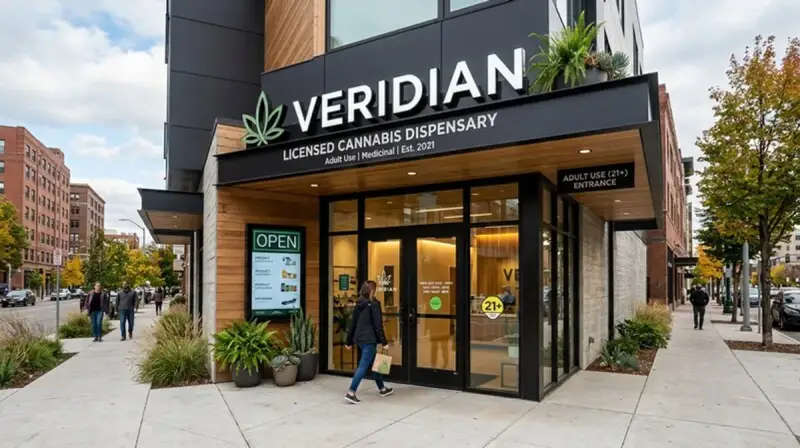
Michigan’s cannabis retail market is regulated by the Marijuana Regulatory Agency (MRA), a standalone state agency within the Department of Licensing and Regulatory Affairs. Over 700 MRA-licensed recreational retail locations operate statewide, though distribution is uneven due to the municipal opt-out provision.
Municipal opt-out: Michigan’s MRTMA required municipalities to actively opt in to allow recreational retail. Approximately 350 municipalities opted out, meaning residents in those areas must travel to neighboring communities to access licensed stores. Detroit, Grand Rapids, Lansing, Ann Arbor, Kalamazoo, Flint, and Traverse City are among the major opt-in markets with multiple licensed dispensaries.
Delivery is available from licensed retailers with an MRA delivery endorsement. Consumers can order online or by phone and receive delivery to a residence. Same-day and next-day delivery is widely available in major metro areas. Delivery vehicles must comply with MRA tracking and documentation requirements.
Out-of-state visitors may purchase and possess recreational cannabis in Michigan with valid government-issued ID confirming age 21+. Same possession limits as residents apply. Taking cannabis across Michigan’s borders — to Ohio, Indiana, Wisconsin, or across the Canadian border at Windsor — is a federal crime and subject to severe penalties at border crossings.
The Michigan Social Equity Program provides priority licensing, fee waivers, technical assistance, and business development support to applicants from communities disproportionately impacted by past cannabis enforcement. Detroit and Flint have been highlighted as priority social equity zones.
Employment and Housing Rights
Employment protections for cannabis users in Michigan are mixed and evolving through legislative interpretation and case law. Michigan’s MRTMA includes language that limits employer discrimination against applicants solely based on a positive cannabis pre-employment drug test in some contexts, though courts have interpreted this narrowly and the protections are not equivalent to those in states like New Jersey or New York.
Safety-sensitive roles — those regulated by federal agencies, positions involving heavy machinery, healthcare roles with patient safety implications, and law enforcement — retain full drug testing authority without restriction. Federal employees and contractors are governed by federal law.
| Employment / Housing Area | Michigan Status |
|---|---|
| Pre-employment testing — most private roles | Limited MRTMA protections; contested; employer largely retains discretion |
| Safety-sensitive roles | No protection; full employer discretion |
| Federal / federally regulated roles | No protection |
| Medical patient employment protection | Some protections under MMMA; case law developing |
| Rental housing cannabis use | No statewide protection; landlord may prohibit in lease |
| Rental housing cultivation | Landlord may prohibit cultivation per lease terms |
Medical cannabis patients in Michigan have historically received somewhat stronger employment protections under the Michigan Medical Marihuana Act (MMMA) than recreational users under MRTMA, based on case law from the Michigan Court of Appeals. However, no Michigan statute currently provides blanket protection against cannabis-related adverse employment actions for recreational users.
Michigan Medical Cannabis Program (MMMA)
Michigan passed Proposal 1 of 2008, the Michigan Medical Marihuana Act (MMMA), making it one of the earliest Midwest states to legalize medical cannabis. The MMMA is administered by the Michigan Department of Licensing and Regulatory Affairs (LARA). Patients must obtain a physician certification and register for a medical cannabis card.
Key medical patient benefits versus recreational:
- Tax savings: Medical patients pay only 6% sales tax (not the 10% excise), saving approximately 10% on every purchase
- Home grow: Up to 12 plants per registered patient (same as recreational limit, but caregiver grows for up to 5 patients are a major advantage)
- Caregiver system: A registered caregiver may grow for up to 5 patients simultaneously (up to 60 plants total), supplying patients who cannot grow themselves
- Access to medical-tier products: Some products available only at licensed medical dispensaries or sections, including higher-THC concentrations or larger quantities per transaction
- Limited employment protections: Stronger than recreational; MMMA has been interpreted by courts to provide some discrimination protection in employment contexts
Qualifying conditions for Michigan medical cannabis cards include cancer, HIV/AIDS, glaucoma, hepatitis C, ALS, PTSD, Crohn’s disease, ulcerative colitis, nail patella syndrome, Alzheimer’s disease, seizure disorders, and severe chronic pain. Many physicians also certify patients for severe nausea, cachexia, and wasting syndrome.
Michigan medical dispensaries and recreational retailers frequently operate from the same location, with designated medical purchasing areas or registered patient queues. Prices at the medical counter are lower due to the tax differential.
Penalties for Exceeding Possession Limits
| Offense | Classification | Potential Penalty |
|---|---|---|
| Possession of 2.5 oz – 5 oz (over limit) | Civil infraction | $500 fine |
| Possession of 5 oz or more | Misdemeanor | Up to 1 year, $2,000 fine |
| Possession with intent to distribute (unlicensed) | Felony (quantity-dependent) | Up to 15 years depending on quantity |
| Sale to a minor | Felony | Up to 2 years; enhanced if pattern |
| Public consumption | Civil infraction | $100 fine |
| Unlicensed cultivation beyond 12 plants | Misdemeanor to felony (scale-dependent) | Varies by plant count and circumstances |
Watch: Cannabis Laws Overview
Related State Guides
- Illinois Cannabis Laws →
- Ohio Cannabis Laws →
- Minnesota Cannabis Laws →
- Colorado Cannabis Laws →
- Washington Cannabis Laws →
- New York Cannabis Laws →
View All 50 US State Cannabis Laws → | Legalization by State Overview →
How Long Does Weed Stay in Your System? → | Cannabis Effects Guide →