
Reviewed by the ZenWeedGuide Policy Team — laws verified
- I-502 passed November 2012; Washington and Colorado were the first two US states to legalize recreational cannabis
- First licensed retail sales opened July 2014 under WSLCB oversight
- Possession limit: 1 oz flower, 7 g concentrate, 16 oz infused solid, 72 oz infused liquid
- Home cultivation is completely prohibited for recreational users — unique among legal states
- 37% excise tax at retail — among the highest cannabis tax rates in the US
- Medical program was merged into the recreational system; no public consumption permitted statewide
Washington State Cannabis: Quick Reference
| Category | Rule |
|---|---|
| Possession limit (flower) | 1 oz (28 g) |
| Possession limit (concentrate) | 7 grams |
| Possession limit (infused solid) | 16 oz (e.g. edibles) |
| Possession limit (infused liquid) | 72 oz (e.g. beverages) |
| Home cultivation | Prohibited (no recreational home grow) |
| Purchase age | 21+ |
| Medical program | Integrated into recreational system |
| Recreational legal since | 2012 vote; sales from July 2014 |
| Regulator | Washington State Liquor and Cannabis Board (WSLCB) |
| State excise tax | 37% (one of highest in US) |
| Public consumption | Prohibited statewide |
Recreational Use Laws
Initiative 502, co-authored by former US Attorney John McKay and supported by a broad coalition including civil liberties groups and law enforcement reformers, passed with 55.7% of the vote in November 2012. Washington and Colorado simultaneously became the first jurisdictions in the world to legalize recreational cannabis for adults. The Washington State Liquor and Cannabis Board (WSLCB) was tasked with developing the regulatory framework, and the first licensed retail stores opened in July 2014.
Washington’s approach was deliberately modeled after alcohol regulation: a strictly licensed, state-controlled retail system with no home production. This makes Washington unique among legal cannabis states in its complete prohibition on recreational home cultivation — a restriction that has remained controversial among cannabis advocates since I-502 was passed.
Possession Limits
Adults 21 and older may legally possess the following amounts at any one time:
- 1 ounce (28 grams) of useable cannabis (dried flower)
- 7 grams of cannabis concentrate (wax, shatter, oil, etc.)
- 16 ounces of cannabis-infused product in solid form (edibles)
- 72 ounces of cannabis-infused product in liquid form (beverages, tinctures)
These limits are per category — possessing 1 oz of flower does not affect your allowable concentrate amount. Exceeding these limits is a misdemeanor offense. Possession of over 40 grams (approximately 1.4 oz) of flower constitutes a felony.
Home Cultivation: Completely Prohibited
Washington State is the only major recreational cannabis state that completely prohibits home cultivation for recreational adults. Under I-502 and subsequent RCW 69.50, there is no provision for adults to grow cannabis plants at home for personal use. This applies regardless of how many plants are involved — even a single plant is illegal for non-medical, non-licensed individuals.
Washington’s home grow ban has been challenged by cannabis advocates repeatedly. Various legislative proposals to allow limited home cultivation have been introduced in the Washington State Legislature but have not passed as of the time of publication. Medical cannabis patients in Washington are also restricted from home cultivation under the current integrated system, unlike medical patients in many other states.
Public Consumption
Public consumption of cannabis is prohibited throughout Washington State. Smoking, vaping, dabbing, or consuming edibles in any public space — including parks, sidewalks, vehicles, and outside cannabis stores — is illegal. Violations are civil infractions. Washington does not currently have a statewide social consumption licensing framework, though there have been legislative discussions about creating one for licensed venues.
Medical Cannabis in Washington State
Washington established a medical cannabis program under the Washington State Medical Use of Cannabis Act in 1998 (Initiative 692), making it one of the earliest state medical cannabis programs in the country. In 2016, Washington integrated its medical program into the existing recreational retail framework, eliminating a separate medical-only dispensary tier. Medical patients in Washington now purchase from the same licensed retailers as recreational customers, but are recognized through a state authorization database and receive tax exemptions and higher purchase limits.
Medical Authorization and Benefits
Patients must obtain a medical authorization from a licensed health care practitioner and can be entered into the voluntary Medical Cannabis Authorization Database (MCAD). Authorized patients and designated providers may purchase up to 3 ounces of cannabis flower per transaction (versus 1 oz for recreational), and may possess up to 3 ounces outside the home. Medical patients are also exempt from the retail excise tax (37%), making medical authorization financially significant for regular users. Qualifying conditions include terminal illness, intractable pain, epilepsy, spasticity, PTSD, and other specified conditions.
The 37% Excise Tax: Washington’s Revenue Model
Washington’s 37% excise tax on retail cannabis sales is among the highest in the United States and represents a deliberate policy decision to generate substantial public revenue. The tax is applied at the point of retail sale and is in addition to standard Washington sales tax (which varies by locality but averages around 10%). Combined tax burden on a recreational cannabis purchase in Washington can exceed 47% of the retail price.
| State | Cannabis Excise Tax Rate | Notes |
|---|---|---|
| Washington | 37% | One of the highest in the US; on top of sales tax |
| California | 15% | Plus local taxes; effective rate often 25%+ |
| Colorado | 15% | Plus 2.9% state sales tax and local taxes |
| Illinois | 10%–25% | Tiered by THC potency |
| Maine | 10% | Plus standard sales tax |
| Oregon | 17% | Plus up to 3% local tax |
Cannabis tax revenue in Washington is distributed to the state general fund, health care programs, substance use disorder prevention, youth drug prevention programs, and the University of Washington’s cannabis research program. Washington has generated over $1 billion in cannabis tax revenue since retail sales began.
Dispensary Access in Washington: Seattle and Beyond
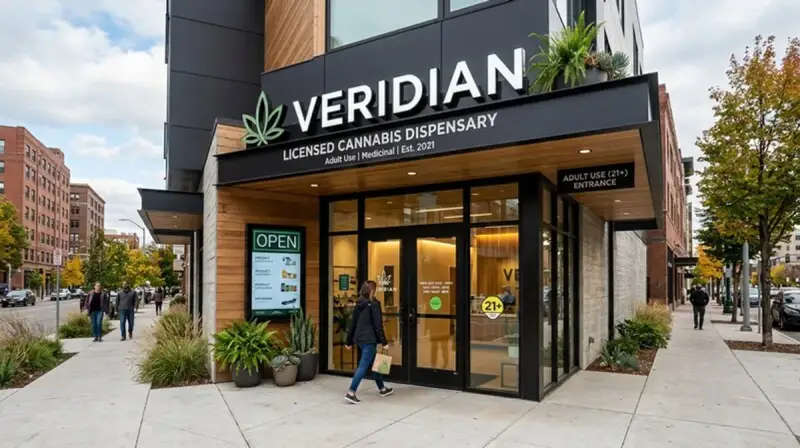
The WSLCB licenses and regulates all cannabis retailers in Washington State. Unlike some states, Washington does not allow municipalities to opt out entirely — though local jurisdictions can impose additional regulations and zoning restrictions on where stores may locate. Seattle has one of the highest concentrations of licensed cannabis retailers per capita in any major US city. The city’s cannabis retail industry is competitive, with stores ranging from small specialty shops to large multi-brand retail operations.
Purchasing at a Washington Dispensary
Bring a valid government-issued photo ID proving you are 21 or older. Both in-state and out-of-state IDs are accepted. Recreational customers may purchase up to 1 ounce of flower per transaction. Dispensary staff will scan or verify your ID at the door before entry. Many Washington stores operate with a check-in area and a separate sales floor. Online pre-ordering and in-store pickup are widely available in Seattle and other cities. Cash is accepted everywhere; many stores also accept debit cards via PIN transactions. Recreational customers pay the full 37% excise tax plus sales tax; medical patients with MCAD authorization pay a reduced rate.
Tribal Cannabis on Reservation Land
Several Washington State tribes have established their own cannabis programs on tribal land under agreements negotiated with the Washington State Liquor and Cannabis Board. Tribal cannabis operations exist in a unique legal zone: tribal sovereignty means tribal governments may establish their own cannabis regulatory frameworks, and in Washington, inter-governmental agreements (IGAs) allow tribes to sell cannabis to non-tribal members in some cases. Tribal cannabis stores may have different possession limits, product rules, or pricing than state-licensed retailers. Always verify the specific rules at any tribal cannabis outlet before purchasing.
Penalties for Cannabis Violations in Washington
| Violation | Penalty | Notes |
|---|---|---|
| Public consumption | Civil infraction, $100 fine | Not a criminal offense |
| Possession over 1 oz (up to 40 g) | Misdemeanor | Up to 90 days jail, $1,000 fine |
| Possession over 40 g | Felony | Class C felony; up to 5 years prison |
| Home cultivation (any amount) | Misdemeanor or felony depending on quantity | No legal home grow in Washington |
| Delivery or sale without license | Felony (Class B or C) | Scales with quantity and prior record |
| Underage possession (under 21) | Misdemeanor; drug education diversion | Juvenile diversion often applied |
| Cannabis DUI | Misdemeanor; license suspension, fines, possible jail | 5 ng/mL THC blood limit (per se standard) |
Cannabis DUI in Washington State
Washington established a 5 nanograms per milliliter (ng/mL) THC in whole blood as a per se DUI limit under RCW 46.61.502. Unlike Colorado, where this is a rebuttable presumption, Washington’s 5 ng/mL limit is a per se standard — meaning that exceeding it is itself a criminal offense without requiring additional proof of impairment. This is a notably strict standard given that THC can remain in the bloodstream long after impairment has passed, particularly for regular users. Law enforcement may also use field sobriety tests and Drug Recognition Experts (DREs) to establish impairment at any THC level.
Employer and Housing Rights
Washington employers generally retain the right to drug test employees and take adverse action based on positive cannabis tests, even for off-duty recreational use. Washington is an at-will employment state. However, the Washington State Supreme Court and lower courts have been active in this area, and some decisions have explored the intersection of disability accommodation and cannabis use for medical patients. Employers in safety-sensitive industries and federal contractors are required to maintain drug-free workplace policies.
Landlords in Washington may prohibit cannabis smoking and possession on rental properties. Tenants in federally subsidized housing are prohibited from cannabis possession and use as a condition of federal funding requirements, regardless of Washington state law.
Interstate Travel Warning
Cannabis remains federally illegal. Crossing any state border with cannabis — including driving into Oregon (which also has legal cannabis) or Idaho (which prohibits cannabis entirely) — is a federal offense. Federal highways, I-90, national parks including Mount Rainier and Olympic, and Seattle-Tacoma International Airport all operate under federal jurisdiction. Do not transport cannabis across state lines under any circumstances.
Frequently Asked Questions
How much cannabis can you possess in Washington State?
Adults 21 and older may possess up to 1 ounce of flower, 7 grams of concentrate, 16 ounces of infused solid products, or 72 ounces of infused liquid products. These limits apply simultaneously by category.
Can you grow cannabis at home in Washington State?
No. Washington State completely prohibits home cultivation for recreational users. This makes Washington unique among major legal cannabis states. Even a single plant grown at home by an adult for personal use is illegal. There is no home grow provision for recreational or medical cannabis under current Washington law.
What is the cannabis tax rate in Washington State?
Washington imposes a 37% excise tax on retail cannabis sales, one of the highest in the US. This is charged at the point of sale in addition to standard sales tax, which can bring the effective total tax rate on a recreational purchase to over 45%.
Is cannabis legal in Seattle specifically?
Yes. Seattle is within Washington State and recreational cannabis is fully legal for adults 21 and older. Seattle has a large number of licensed dispensaries throughout the city. Consumption is limited to private property — public consumption is illegal statewide.
Further Reading
