










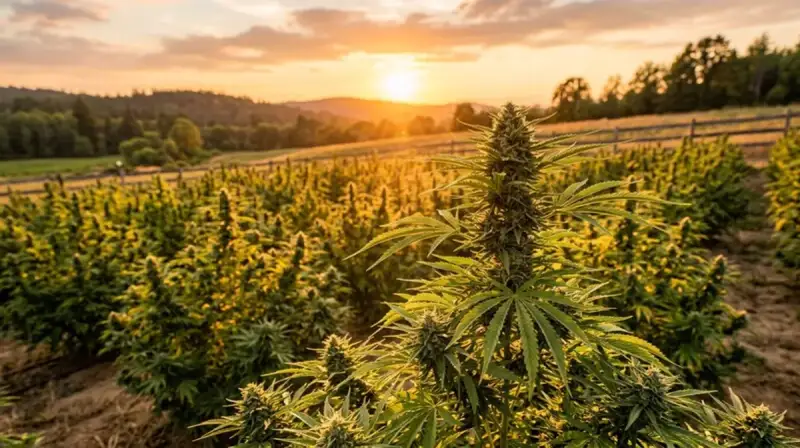
- Genetics: Haze (Colombian × Mexican × Thai × South Asian landraces) crossed with a purple indica phenotype — the exact lineage is disputed, but all paths trace to Original Haze as the sativa backbone.
- Named after Hendrix, not vice versa: Jimi Hendrix wrote “Purple Haze” in November 1967. The cannabis strain was bred decades later by Dutch cultivators who named it after the song. The strain did not inspire the music.
- Terpinolene-dominant: The primary terpene drives the cerebral, uplifting, slightly floral character. Terpinolene is shared with Jack Herer, Super Silver Haze, and Ghost Train Haze — all sativas with similar effect profiles.
- Purple requires a trigger: Anthocyanin expression (the purple coloration) requires cool night temperatures below 15°C/59°F during late flowering AND genetic predisposition. Not all phenotypes turn purple regardless of temperature.
- 10–11 week flower time is longer than average — a direct consequence of Haze landrace genetics that evolved near the equator and are not adapted to shorter day lengths.
- Effects are cerebral-first: Euphoric onset, creative stimulation, elevated mood, mild sensory enhancement. Less body sedation than indica-leaning strains. Best suited for creative tasks, social settings, and daytime use.
- Medical value: Depression, stress, fatigue, and creative blocks respond well to the dopaminergic stimulation from the sativa-leaning terpene and cannabinoid profile.
Genetics & Lineage
Purple Haze traces its sativa backbone to Original Haze — the legendary multi-landrace hybrid assembled from Colombian, Mexican, Thai, and South Asian cannabis that became the foundation of Amsterdam’s premium sativa market in the 1980s and early 1990s. Original Haze itself was developed in California in the 1960s and 1970s, reportedly by breeders known as the Haze Brothers who combined equatorial landraces from multiple continents.
The “purple” dimension of Purple Haze comes from a cross with an indica phenotype selected for anthocyanin expression — the genetic trait that enables purple coloration under cool conditions. The identity of this indica parent is not definitively documented, and different seed companies have produced versions under the Purple Haze name using different genetic interpretations. What is consistent across authentic Purple Haze genetics is the Haze-derived terpinolene-dominant terpene profile and the purple-capable phenotype when properly triggered.
The strain’s cultural naming came later: Dutch breeders and seed companies in the early 1990s, drawing on the psychedelic associations of Hendrix’s 1967 song, applied the name to Haze genetics that produced the purple phenotype. The result was a commercially and culturally successful naming that endures despite the historical inversion — the song came first by more than two decades.
Terpene Profile & Cannabinoid Composition
| Compound | Typical % | Aroma Notes | Effect Contribution |
|---|---|---|---|
| Terpinolene | 0.4–1.2% | Floral, herbal, slightly citrus, piney | Primary driver of uplifting, cerebral, anti-anxiety effect; short-acting; shared with Jack Herer and SSH |
| Myrcene | 0.3–0.8% | Earthy, musky, slight herbal | Mild sedative at high concentrations; at these levels adds body warmth without sedation |
| Ocimene | 0.2–0.5% | Sweet, herbal, woody | Potential antiviral, mood-elevating; contributes to sweet complexity of aroma |
| Phellandrene | 0.1–0.3% | Peppery, minty, slightly citrus | Energising, antidepressant potential; contributes to the “crisp” note in the aroma |
| THC | 17–20% | — | Euphoric onset, mild psychedelia, creative stimulation |
| CBD | <0.5% | — | Minimal; does not significantly modulate THC effect at these levels |
Terpinolene-Dominant Sativa Comparison
Terpinolene is the defining terpene of a specific class of uplifting sativas. Understanding where Purple Haze sits in this family helps identify similar strains and predict effect character:
| Strain | Terpinolene Level | Energy Level | Cerebral Intensity | Flower Time | Grow Difficulty |
|---|---|---|---|---|---|
| Purple Haze | Primary (high) | High | High — mild psychedelia at top doses | 10–11 weeks | Moderate — tall, patience required |
| Jack Herer | Primary (high) | High — clear-headed | High — focused, functional | 8–10 weeks | Moderate |
| Super Silver Haze | Primary (very high) | Very high | Very high — intense, some anxiety risk | 9–11 weeks | Moderate–Hard |
| Ghost Train Haze | Primary (extreme) | Extreme | Extreme — not for beginners | 10–12 weeks | Hard |
Cultural History: The Hendrix Connection Explained
| Date | Event | Significance |
|---|---|---|
| November 1967 | Jimi Hendrix records “Purple Haze” at Olympic Studios, London | Song title derived from a dream Hendrix described — psychedelic, not cannabis-specific |
| 1960s–70s | Haze Brothers develop Original Haze in Santa Cruz, California | Foundation genetics; no connection to Hendrix or purple strains yet |
| 1980s | Original Haze genetics arrive in Amsterdam via Nevil Schoenmakers | Sensi Seeds and others begin working with Haze in Netherlands |
| Early 1990s | Dutch breeders produce purple-phenotype Haze crosses | First strains marketed as “Purple Haze” — name directly from Hendrix song |
| 2000s | Purple Haze appears on Amsterdam coffee shop menus; seed banks release commercial versions | Strain name becomes globally recognised; multiple versions proliferate |
| Post-2010 | Purple Haze available at US dispensaries in recreational states | Cultural iconography transitions from European to American market dominance |
| Today | Multiple seed companies produce Purple Haze variations with different genetic interpretations | The name is culturally canonical even as specific genetics vary between producers |
Anthocyanin Expression: Why Purple Haze Turns Purple
The purple coloration of Purple Haze is not always present — it requires both genetic predisposition and environmental conditions. Anthocyanins are flavonoid compounds stored in the vacuoles of plant cells. In most cannabis plants, green chlorophyll dominates visually during the flowering period. When temperatures drop below approximately 15°C/59°F at night during the final 2–3 weeks of flowering, chlorophyll synthesis decreases while anthocyanin concentrations become visible. The resulting colour ranges from violet to deep purple depending on pH and the specific anthocyanin compounds expressed.
Not all Purple Haze phenotypes contain the anthocyanin gene variant necessary for purple expression. Growers who attempt to trigger purple coloration in a non-anthocyanin phenotype through cold temperatures will achieve purple stress (pale/yellow tips) rather than deep purple buds — a cosmetic difference with no quality benefit. Authentic purple-capable genetics will show clear anthocyanin expression within 48–72 hours of consistent cool nights during the final weeks of flower.
The purple coloration has no documented effect on cannabinoid or terpene content. It is a visual phenotypic trait with no pharmacological significance, though it has considerable commercial value in consumer markets.
Effects & Medical Applications
Purple Haze produces a characteristic sativa-dominant experience: the euphoric onset arrives within minutes of inhalation and is primarily cerebral — mood elevation, creative acceleration, and mild sensory enhancement. Physical effects are present but secondary, typically manifesting as mild body warmth and slight tension relief without sedation. The terpinolene-dominant profile is associated with shorter-duration peaks compared to caryophyllene or myrcene-dominant strains.
Recreational use: Creative work (writing, music, art), social settings, outdoor activities, and daytime use. The energetic onset makes Purple Haze poorly suited for evenings unless the user has very high tolerance.
Medical considerations: Depression and stress respond well to the dopaminergic stimulation from the sativa-leaning profile. Fatigue and low motivation benefit from the energising terpinolene effect. Anxiety patients should approach cautiously — terpinolene-dominant strains at higher doses can increase anxiety in sensitive individuals due to THC-mediated amygdala activation without the balancing effect of caryophyllene or linalool.
Growing Purple Haze
| Parameter | Specification |
|---|---|
| Flower time (indoor) | 10–11 weeks |
| Outdoor harvest (N. Hemisphere) | Late October |
| Height | 100–200 cm indoor (significant sativa stretch); up to 300 cm outdoor |
| Yield (indoor) | 400–500 g/m² (moderate for the effort) |
| Difficulty | Moderate — manageable for intermediate growers; SCROG or LST recommended to control height |
| Purple trigger protocol | Drop night temperatures to 13–16°C for final 14–21 days of flowering. Gradual transition preferred over sudden cold shock. Verify phenotype is anthocyanin-capable before implementing. |
| Harvest window indicator | 70% cloudy / 30% amber trichomes for peak cerebral effect; more amber = more sedative character |
The primary challenge with Purple Haze is the sativa stretch — plants can double or triple in height during the first two weeks of flowering. Implementing training techniques (SCROG, manifolding, or aggressive LST) from week 3 of vegetative growth significantly improves yields and canopy control. The extended 10–11 week flower time requires patience but produces the full terpene complexity that shorter-flowering crosses cannot replicate.
Was Purple Haze named after the Jimi Hendrix song?
The reverse is true. Hendrix wrote the song in 1967. Dutch breeders in the early 1990s named the strain after the song, not the other way around. The song was inspired by a dream, not by cannabis.
Why does Purple Haze turn purple?
Anthocyanin expression triggered by cool night temperatures below 15°C combined with genetic predisposition. Not all phenotypes turn purple — the genetic trait must be present and the temperature trigger applied during the final 2–3 weeks of flowering.
What are the effects of Purple Haze?
Cerebral euphoria, creative stimulation, elevated mood, mild sensory enhancement. Primarily a head high with mild body warmth. Energising, best for daytime use. Higher doses can produce mild anxiety in sensitive users due to terpinolene-THC interaction.
How long does Purple Haze take to flower?
10–11 weeks indoors due to Haze landrace genetics. This is longer than average but produces the full terpene complexity characteristic of equatorial-origin genetics. Outdoor harvest is late October in the Northern Hemisphere.