


Reviewed by the ZenWeedGuide Policy Team — laws verified May 2026
- Amendment 3 passed November 8, 2022 (53%); retail sales began February 3, 2023
- Public possession: 3 oz flower — one of the highest public limits in the US
- Home storage: 6 oz; home cultivation: 6 plants (max 3 flowering) per adult
- State excise tax: 6% recreational, 4% medical — among the lowest in any legal state
- Automatic expungement mandated for prior possession convictions up to 3 oz
- Employers retain full drug testing rights; no broad off-duty use protections
- Missouri Division of Cannabis Regulation (DCR) oversees licensing and enforcement
- Medical program (Amendment 2, 2018) integrated into unified recreational framework
Missouri Cannabis: Quick Reference
| Category | Rule |
|---|---|
| Recreational legal status | Legal — retail sales since February 2023 |
| Minimum purchase age | 21+ |
| Public possession limit | 3 oz (85 g) flower |
| Home storage limit | 6 oz usable cannabis |
| Home cultivation | 6 plants per adult (3 flowering maximum) |
| State excise tax (recreational) | 6% |
| State excise tax (medical) | 4% |
| Local sales tax | Up to 3% municipality |
| Standard Missouri sales tax | 4.225% |
| Expungement | Automatic for eligible low-level convictions |
| Employer testing rights | Employers may test and enforce drug-free policies |
| Medical program | Active since 2020 (Amendment 2, 2018) |
| Regulator | Missouri Division of Cannabis Regulation (DCR) |
Legislative History
Missouri voters approved Amendment 3 on November 8, 2022, with 53% in favor — a notable margin in a state that had voted Republican in every presidential election since 1996. The amendment took effect on December 8, 2022. Licensed recreational sales began on February 3, 2023, as the existing medical dispensary network converted to dual-use operations, giving consumers immediate access to established retail infrastructure.
The Missouri Division of Cannabis Regulation (DCR) was established within the Department of Commerce and Insurance to administer the program. Missouri’s framework merged the existing medical dispensary infrastructure — built after voters approved Amendment 2 for medical cannabis in November 2018 — with the new recreational framework, creating a unified regulatory structure rather than two parallel systems.
Missouri’s 3-ounce public possession limit is one of the most generous in the country and was a deliberate policy choice to minimize the criminalization of personal-use amounts that had historically driven mass arrests in St. Louis and Kansas City. The 6% excise tax was similarly designed to compete aggressively with the illicit market by keeping legal cannabis affordable.
Possession Limits in Detail
| Location | Product | Limit |
|---|---|---|
| Public | Flower | 3 oz (85 g) |
| Public | Marijuana-infused products | Per product THC equivalency |
| Home storage | All usable cannabis | 6 oz |
| Per dispensary transaction | Flower | 3 oz |
| Per dispensary transaction | Concentrates | Equivalent to 3 oz flower |
| Medical patients (public) | All cannabis | Higher limits per certification |
Marijuana-infused products (MIPs) — including edibles, tinctures, and topicals — are specifically regulated and included in Amendment 3’s possession framework. The 6-ounce home storage cap applies to usable cannabis of all product types combined. Possession of amounts clearly inconsistent with personal use may attract distribution charges regardless of technical compliance with the 6-ounce limit.
Home Cultivation Rules
Amendment 3 permits home cultivation for personal use. The rules distinguish between total plants and simultaneously flowering plants to balance perpetual grow capability with production limits:
| Rule | Detail |
|---|---|
| Total plants per adult | 6 |
| Simultaneously flowering plants | 3 maximum at any time |
| Primary residence requirement | Must be cultivator’s primary residence |
| Visibility restriction | Not visible to public or neighboring properties |
| Security requirement | Locked, enclosed space; inaccessible to minors |
| Home-grown storage | Must remain within 6 oz home limit |
| State registration | No registration required for personal grows |
Dispensary and Purchase Rules
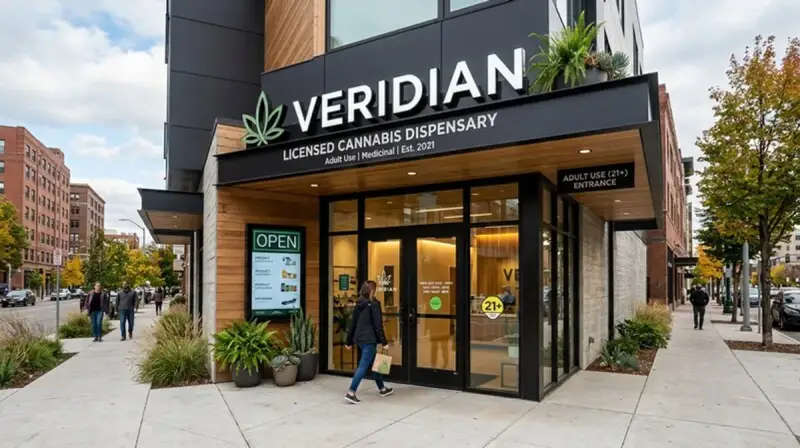
Licensed dispensaries must verify age at every transaction with valid government-issued photo ID. No residency requirement applies; out-of-state visitors 21 and older may purchase freely. Missouri’s dispensary network is concentrated in Kansas City, St. Louis, Springfield, and Columbia. Rural access remains significantly limited; some western and southern Missouri counties have no licensed retailers within a practical driving distance.
Local governments may impose reasonable time, place, and manner restrictions on cannabis retail but may not prohibit cannabis businesses outright under Amendment 3. This gives Missouri consumers stronger retail access protections than states like California where cities may ban dispensaries. Cannabis delivery is permitted for licensed retailers; availability varies by operator and geography.
Tax Structure
Missouri’s 6% recreational excise is among the lowest flat rates in any legal US state. The medical rate of 4% provides additional savings for registered patients. Standard Missouri sales tax and local taxes compound on top of the excise, but total effective rates remain among the most consumer-friendly in the Midwest:
| Tax Component | Rate | Notes |
|---|---|---|
| State recreational excise tax | 6% | One of the lowest rates in any legal state |
| State medical excise tax | 4% | Medical cardholders benefit significantly |
| Local municipality tax | Up to 3% | Varies by city; not universal |
| Standard Missouri sales tax | 4.225% | Statewide base rate |
| Combined effective rate (Kansas City) | Approximately 13–15% | Including local sales tax |
Driving Under the Influence of Cannabis
Driving under the influence of cannabis is a criminal offense in Missouri. There is no per se THC blood-level threshold in Missouri’s DUI statute. Law enforcement relies on observed impairment, standardized field sobriety tests, and Drug Recognition Evaluator assessments to establish impairment. A first DUI conviction carries mandatory fines, license suspension, and potential jail time. Cannabis must be stored in a sealed container or the trunk while in a vehicle. Consuming cannabis in a vehicle — as a driver or passenger — is prohibited.
Employment and Housing Rights
Missouri employers retain the right to maintain drug-free workplace policies and may test for cannabis through pre-employment, random, and for-cause testing programs without restriction. Amendment 3 does not prohibit employer testing or require employers to accommodate lawful off-duty cannabis use. Federal contractor and safety-sensitive employers are required to maintain testing programs under federal law. Missouri is one of the less employee-protective legal states regarding cannabis workplace testing rights.
Landlords may prohibit cannabis smoking and cultivation in rental properties. Federally subsidized housing applies federal cannabis prohibitions. Workers’ compensation coverage may be affected when cannabis impairment is found to have contributed to a workplace injury.
Expungement of Prior Convictions
One of Amendment 3’s most impactful provisions is the mandatory automatic expungement of eligible cannabis convictions. Missouri courts are required to review and expunge records for individuals convicted of possessing up to 3 ounces of flower (or equivalent amounts of other cannabis products), cannabis paraphernalia, and related low-level offenses now legal under Amendment 3. Courts process these without requiring petitions from affected individuals.
Convictions involving sale, distribution, possession with intent to distribute, or possession of amounts substantially exceeding 3 ounces are not automatically expunged. Individuals with such convictions may file petitions with the court in the county where the conviction occurred. Amendment 3 also extended social equity licensing preferences to individuals with cannabis conviction history, creating pathways into the legal industry for those most harmed by prior enforcement.
Local Jurisdiction Rules
Amendment 3 prevents local governments from enacting outright bans on cannabis businesses, a stronger pre-emption clause than many legal states provide. Local governments may impose reasonable zoning, operational hours, and other time/place/manner restrictions. St. Louis City, Kansas City, Springfield, and Columbia have active legal retail markets with multiple competing dispensaries. Rural counties have far fewer retailers despite the lack of ban authority, due to lower population density and commercial interest in those markets.
Medical Cannabis Program
Missouri voters approved medical cannabis through Amendment 2 in November 2018. The program became operational in 2020 and was fully integrated into the unified regulatory framework under Amendment 3. Medical patients benefit from the lower 4% excise tax rate and higher possession and purchase limits. Qualifying conditions include cancer, epilepsy, PTSD, chronic pain, multiple sclerosis, HIV/AIDS, ALS, intractable migraines, sickle cell anemia, and any debilitating condition for which cannabis provides therapeutic relief per a licensed physician’s recommendation.
Interstate Transportation Rules
Cannabis purchased in Missouri must remain in Missouri. Missouri borders eight states: Iowa, Illinois, Kentucky, Tennessee, Arkansas, Oklahoma, Kansas, and Nebraska. All except Illinois have either prohibition or limited medical programs. Transporting cannabis across any Missouri state border is a federal offense under the Controlled Substances Act regardless of which state the cannabis is entering. I-70, I-44, and I-55 are all subject to federal jurisdiction at state-line crossings.
Penalty Reference Table
| Violation | Classification | Potential Penalty |
|---|---|---|
| Public consumption | Civil infraction | Up to $100 fine |
| Possession 3–6 oz in public | Civil infraction | Fine within personal-use range |
| Possession over 6 oz | Misdemeanor or felony | Fines; possible imprisonment |
| Unlicensed sale | Felony | Significant fines and imprisonment |
| Sale to minors | Felony (enhanced) | Prison time; mandatory minimum |
| Cannabis DUI | Criminal misdemeanor / felony | Fines; license suspension; jail |
| Possession on school grounds | Felony enhancement | Near schools or youth facilities |
Frequently Asked Questions
Can out-of-state visitors buy cannabis in Missouri?
Yes. Missouri imposes no residency requirement for cannabis purchases. Adults 21 and older with valid government-issued photo ID may purchase at any licensed dispensary. Transporting cannabis across the Missouri state line in any direction remains a federal offense.
Does Amendment 3 allow social cannabis consumption lounges?
Amendment 3 does not explicitly create a social consumption lounge framework. Consumption remains limited to private property. The Division of Cannabis Regulation may develop rules for consumption venues in the future. As of May 2026, Kansas City and St. Louis have not yet authorized operational consumption venues.
How do I know if my prior conviction qualifies for automatic expungement?
Eligible convictions include those for possessing up to 3 ounces or the equivalent amount of other cannabis products, cannabis paraphernalia, and related low-level offenses now legal under Amendment 3. Courts process these automatically. For offenses outside the automatic category, consult a Missouri attorney who handles expungement petitions in the county where the conviction occurred.
What is the St. Louis City cannabis enforcement culture?
St. Louis City adopted a progressive enforcement posture aligned with the Amendment 3 framework. Civil infractions receive civil treatment. The city’s prosecutorial discretion guidelines generally deprioritize cannabis enforcement for amounts within personal-use thresholds. Rural Missouri counties historically had higher per-capita cannabis arrest rates and may apply civil fine structures more assertively for infractions.
Are marijuana-infused products treated the same as flower under Missouri law?
Yes. Amendment 3 explicitly includes marijuana-infused products (MIPs) within the possession and purchase framework. Edibles, tinctures, capsules, and topicals are regulated and counted within personal-use limits on a THC-equivalency basis. Purchase limits per transaction include MIPs within the overall 3-ounce equivalent cap.