Recreational
Legal Status
✓
Last reviewed: May 2026 — Verified against official Rhode Island state sources
Key Facts — Cannabis in Rhode Island
- Legal Status: Recreational — HB 7593 signed May 2022, retail sales began December 2022
- Possession: 1 oz in public; up to 10 oz at home
- Home Grow: 3 plants per person (max 2 mature); 6 plants per household (max 4 mature)
- Tax Rate: 10% cannabis excise + 7% state sales tax ≈ 17% total
- Regulator: Office of Cannabis Regulation (OCR) under the Rhode Island Department of Business Regulation
- Medical Program: Active since 2006 — among the earliest state medical cannabis programs nationally
- Geographic Note: Smallest state to legalize; borders Massachusetts (legal since 2018), creating competitive pricing pressure
Yes — Rhode Island Governor Dan McKee signed HB 7593 on May 25, 2022, legalizing adult-use cannabis through the Rhode Island Cannabis Act. The state became the 19th in the nation to legalize recreational cannabis, and the smallest state by area to do so at that time. Adult-use retail sales commenced on December 1, 2022.
Rhode Island’s legalization came through the state legislature rather than a voter ballot initiative — a reflection of strong political will in the General Assembly. Rhode Island had already decriminalized small cannabis possession in 2013, which smoothed the path to full legalization.
An important geographic factor: Rhode Island shares a border with Massachusetts, which legalized recreational cannabis in 2018. The cross-border cannabis trade had been a notable economic leakage issue for Rhode Island prior to legalization, and the state moved to capture that revenue locally.
Rhode Island sets a 1-ounce public possession limit for adults 21 and older. At home, adults may keep up to 10 ounces. Exceeding these limits carries graduated penalties.
| Situation | Amount | Classification | Penalty |
|---|
| Legal public possession | Up to 1 oz | Legal | None |
| Legal home possession | Up to 10 oz | Legal | None |
| Over-limit possession (minor) | 1–2 oz over limit | Civil violation | Fine up to $150 |
| Large quantity possession | Significant over-limit | Criminal | Varies by amount |
| Legal home grow | Up to 3 plants (2 mature) | Legal | None |
| Public consumption | Any amount | Civil violation | Fine up to $150 |
| Sale without license | Any amount | Criminal | Varies by quantity |
Rhode Island permits adults 21+ to cultivate cannabis at home. Each adult may grow up to 3 plants, but no more than 2 may be mature (flowering) at any time. A household may not exceed 6 plants total, with a maximum of 4 mature plants regardless of how many adults live there.
Plants must be grown in an area not visible from a public place or accessible to individuals under 21. The cannabis produced from home grows may be kept at home up to the 10-oz limit and shared as gifts (without payment) with other adults.
Rhode Island applies a 10% cannabis excise tax to adult-use sales, plus the standard 7% state sales tax, for a combined rate of approximately 17%. This is a moderate rate compared to neighboring Massachusetts (20%), placing Rhode Island in a competitive position for consumers.
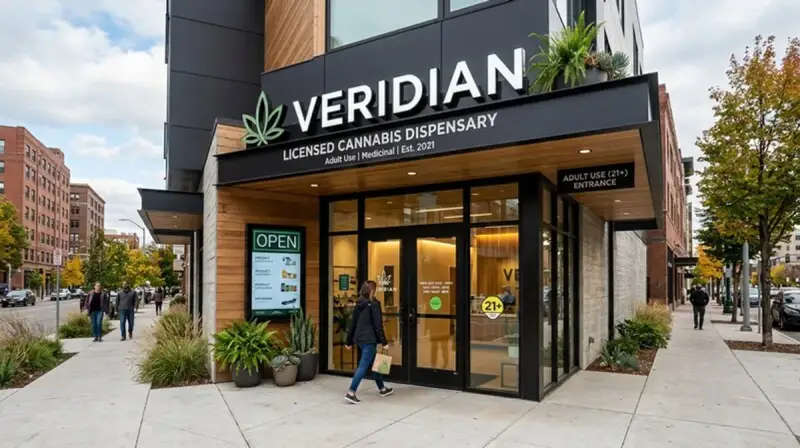
The primary dispensary market is concentrated around Providence, the state’s capital and largest city. Given Rhode Island’s small size — roughly 40 miles wide and 50 miles long — most residents are within a short drive of a licensed dispensary. Several dispensaries along the Massachusetts border have specifically positioned themselves to compete for cross-border consumers.
Licensed adult-use retailers may offer home delivery under the Rhode Island Cannabis Act, expanding access for consumers who cannot easily travel to a storefront.
Rhode Island’s medical cannabis program — the Edward O. Hawkins and Thomas C. Slater Medical Marijuana Act — was signed into law in 2006, making Rhode Island one of the earliest states to establish a medical program. The program has served thousands of qualified patients for nearly two decades.
Qualifying conditions include cancer, glaucoma, HIV/AIDS, Crohn’s disease, agitation from Alzheimer’s disease, PTSD, and other debilitating conditions. Medical patients benefit from no cannabis excise tax (only standard sales tax applies) and higher possession limits compared to adult-use customers.
The Rhode Island Cannabis Act includes social equity licensing provisions designed to ensure communities most harmed by cannabis prohibition benefit from legalization. The Office of Cannabis Regulation (OCR) prioritizes social equity applicants in licensing rounds, reduces fees for qualifying applicants, and provides technical assistance programs.
Social equity applicants include individuals with prior cannabis convictions for conduct now legal under state law, residents of disproportionately impacted areas, and low-income applicants. Rhode Island also has a cannabis expungement process for eligible prior convictions.
| Category | Detail |
|---|
| Legalizing legislation | HB 7593 (Rhode Island Cannabis Act) — signed May 25, 2022 |
| Sales launched | December 1, 2022 |
| Adult-use possession (public) | Up to 1 oz |
| Adult-use possession (home) | Up to 10 oz |
| Home cultivation | 3 plants/adult (2 mature max); 6 plants/household (4 mature max) |
| Legal age | 21+ |
| Regulatory body | Office of Cannabis Regulation (OCR) |
| Medical program | Active since 2006 — Hawkins and Slater Act |
| Delivery | Legal from licensed retailers |
| Neighboring state status | Massachusetts — legal since 2018 |
Can Massachusetts residents buy cannabis in Rhode Island?
Yes. Any adult 21 or older may purchase cannabis from a licensed Rhode Island dispensary regardless of their home state. However, transporting purchased cannabis back across state lines is a federal offense, even though both states have legalized cannabis.
Where can I legally consume cannabis in Rhode Island?
Cannabis may be consumed on private property with the property owner’s permission. Public consumption is prohibited and is a civil violation subject to fine. Rhode Island does not currently have licensed cannabis lounges or social consumption venues.
Do Rhode Island dispensaries accept cash only?
While many cannabis dispensaries historically operated cash-only due to federal banking restrictions, Rhode Island dispensaries increasingly accept debit cards through cashless ATM systems and some accept credit cards. It is always advisable to bring cash as a backup. Dispensary websites typically list accepted payment methods.
Can I grow cannabis in my Rhode Island apartment?
State law permits home cultivation, but landlords may prohibit it under their lease terms. Renters should review their lease agreements before beginning a home grow, as landlord prohibition is enforceable and may result in lease termination.
Whether you are a first-time cannabis buyer or an experienced consumer, knowing what to expect at a licensed dispensary makes the experience smoother. Here are the key things to prepare before your visit.
- Bring valid photo ID: All adults must show government-issued ID (driver’s license, passport, or state ID) proving age 21+. Dispensaries are legally required to verify age and may turn away anyone without valid ID regardless of apparent age.
- Cash is useful: Many dispensaries have ATMs on-site. Some accept debit or credit cards through cashless payment systems; confirm before visiting. Having cash as a backup ensures you can complete your purchase.
- Check the menu online: Most licensed dispensaries publish their product menus online with current prices and availability. Reviewing products and prices in advance helps you make informed decisions and saves time at the counter.
- Ask the budtender: Staff at licensed dispensaries are trained to answer questions about products, potency, effects, and consumption methods. Do not hesitate to ask for guidance, especially if you are new to a product type.
- Start low, go slow: If you are new to cannabis or trying a new product type — especially edibles or concentrates — begin with the lowest available dose and wait at least two hours before consuming more. Edibles have a delayed onset of 30–90 minutes.
- Know the legal purchase limits: You may only purchase up to the legal per-transaction limit at any one dispensary per day. Attempting to purchase above-limit amounts is a violation of state law and may result in refusal of sale.
After your dispensary visit, remember that cannabis must be consumed on private property. Keep purchased cannabis in its original sealed packaging until you are in a legal consumption location, and never consume cannabis while operating or riding in a vehicle.
MW
Marcus Webb
Senior Cannabis Policy Editor
Marcus Webb covers cannabis legislation across all 50 states. He tracks regulatory changes, legislative sessions, and court decisions affecting cannabis consumers and businesses.
Even though cannabis is legal in Rhode Island, federal law and employer policies still apply. Many employers require pre-employment or random drug screening regardless of state law.
The most common pre-employment test is the urine test, which can detect THC metabolites for up to 30 days in regular users. See: How long does THC stay in urine?