Recreational
Legal Status
✓
Last reviewed: May 2026 — Verified against official Connecticut state sources
Key Facts — Cannabis in Connecticut
- Legal Status: Recreational — HB 6377 signed June 2021; retail sales began January 10, 2023
- Possession: 1.5 oz in public; 5 oz at home
- Home Grow: 6 plants per household (max 3 mature); legal as of July 1, 2023
- Tax Rate: 3% cannabis tax + 6.35% sales tax + local option ≈ 15% total
- Regulator: Department of Consumer Protection (DCP) — Cannabis Division
- Social Equity: Social Equity Council — widely regarded as one of the strongest equity programs in the US; prioritizes Hartford and New Haven high-impact areas
- Medical Program: Active since 2012 — Palliative Use of Marijuana Act (PUMA)
Yes — Connecticut Governor Ned Lamont signed HB 6377 (the SAFE-T Act) on June 22, 2021, making Connecticut the 19th state to legalize recreational cannabis. Connecticut chose the legislative route to legalization — the law was passed by the General Assembly rather than via voter ballot initiative. This made it possible to build in stronger regulatory controls and social equity provisions than many ballot-initiative states achieved.
Possession of up to 1.5 ounces became legal immediately upon signing. Licensed adult-use retail dispensaries opened on January 10, 2023, after the Department of Consumer Protection completed the licensing process. Home cultivation became legal on July 1, 2023.
Connecticut’s cannabis law is particularly distinguished by its Social Equity Council (SEC) — an independent body with authority over equity licensing, technical assistance programs, and reinvestment of cannabis tax revenue into disproportionately impacted communities. It is widely regarded as one of the most robust cannabis equity frameworks in the United States.
Connecticut sets a 1.5-ounce public possession limit for adults 21 and older — slightly higher than the 1 oz standard in many states. At home, adults may keep up to 5 ounces. The state has a graduated penalty structure for violations.
| Situation | Amount | Classification | Penalty |
|---|
| Legal public possession | Up to 1.5 oz | Legal | None |
| Legal home possession | Up to 5 oz | Legal | None |
| Over public limit (minor) | 1.5–4 oz | Civil infraction | Fine (amount varies) |
| Significant over-limit | Over 4 oz | Criminal misdemeanor | Up to 1 year / fine |
| Large quantity (trafficking) | Over 1 kg | Felony | 1–10 years |
| Legal home grow | Up to 6 plants (3 mature) | Legal | None |
| Public consumption | Any amount | Civil infraction | Fine |
Connecticut’s Social Equity Council (SEC) is the centerpiece of the state’s approach to cannabis equity. The SEC has independent authority to certify social equity applicants, who receive priority in licensing, application fee waivers, low-interest microbusiness loans, and access to state-funded technical assistance programs.
Social equity applicants are defined as those with prior cannabis convictions for conduct now legal, residents of disproportionately impacted areas (DIAs) — specifically census tracts in Hartford, New Haven, Bridgeport, and other cities with historically high cannabis enforcement rates — and individuals who meet income thresholds. Connecticut allocates a guaranteed portion of cannabis business licenses exclusively to social equity applicants.
| Equity Program Feature | Detail |
|---|
| Social Equity Council | Independent body with equity certification authority |
| License set-asides | Equity applicants guaranteed share of each license class |
| Application fee waivers | Up to 50% reduction for certified equity applicants |
| Microbusiness loans | State-funded low-interest financing available |
| Target communities | Hartford, New Haven, Bridgeport high-impact census tracts |
| Tax revenue reinvestment | Portion of excise tax reinvested into DIA communities |
Connecticut applies a 3% cannabis tax plus the standard 6.35% state sales tax on adult-use cannabis sales. Municipalities may add a local option tax, bringing the typical combined total to approximately 15%. This is a moderate rate compared to neighboring New York or Massachusetts, where total effective tax rates are higher.
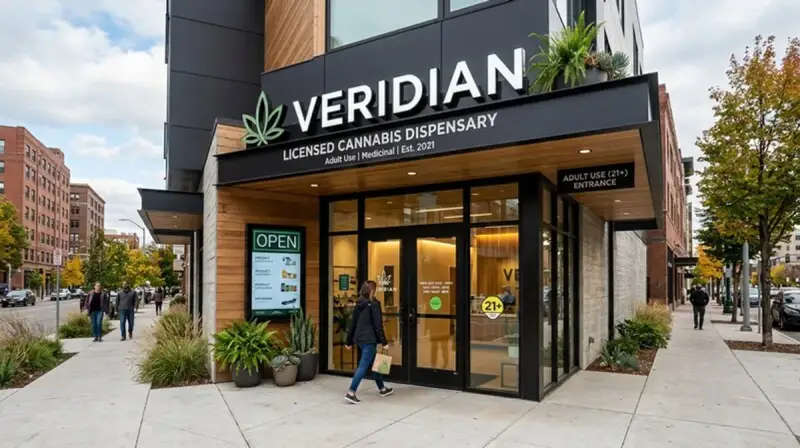
Licensed dispensaries are concentrated in the state’s two largest population centers — Hartford and New Haven — with additional licensed locations in Bridgeport, Stamford, and smaller cities. Connecticut residents also have access to licensed home delivery from retailers, which was built into the law from the outset.
Connecticut’s Palliative Use of Marijuana Act (PUMA), effective since 2012, established the state’s medical cannabis program. Qualifying conditions include cancer, Parkinson’s disease, multiple sclerosis, damage to the nervous system, epilepsy, HIV/AIDS, Crohn’s disease, PTSD, and others as approved by the Department of Consumer Protection.
Medical patients benefit from no cannabis excise tax (only standard sales tax applies), higher per-purchase and possession limits, and access to products formulated specifically for medical use. Patients under 18 may participate with caregiver authorization for qualifying conditions. The medical program continues to run in parallel with the adult-use market.
| Category | Detail |
|---|
| Legalizing legislation | HB 6377 (SAFE-T Act) — signed June 22, 2021 |
| Retail sales launched | January 10, 2023 |
| Home grow legalized | July 1, 2023 |
| Adult-use possession (public) | Up to 1.5 oz |
| Adult-use possession (home) | Up to 5 oz |
| Home cultivation | 6 plants/household (3 mature max) |
| Legal age | 21+ |
| Regulatory body | Department of Consumer Protection (DCP) Cannabis Division |
| Medical program | Active since 2012 (PUMA) |
| Delivery | Legal from licensed retailers |
| Social equity | Social Equity Council — independent authority |
Does Connecticut allow cannabis delivery?
Yes. Connecticut law permits licensed cannabis retailers to offer home delivery to adults 21 and older. Delivery was built into the cannabis regulatory framework from the outset of HB 6377, reflecting an emphasis on consumer convenience and access. Delivery persons must be licensed and deliveries must be made to private residences.
Can Connecticut employers still drug test for cannabis?
Connecticut provides some of the stronger employee protections among legal states. Connecticut’s law restricts employers from taking adverse action solely based on a positive cannabis test for off-duty use by employees who are not impaired at work. However, safety-sensitive positions and federally regulated jobs remain subject to stricter requirements.
What is the Connecticut cannabis DUI threshold?
Connecticut does not set a specific per se blood THC threshold for cannabis DUI. Instead, law enforcement uses behavioral observation, field sobriety testing, and Drug Recognition Expert (DRE) evaluation to assess impairment. A positive blood test combined with behavioral indicators of impairment can support a DUI charge. Driving while impaired by cannabis remains a serious criminal offense in Connecticut.
Can I apply as a social equity applicant in Connecticut?
Connecticut’s Social Equity Council certifies social equity applicants who meet the defined criteria — including prior cannabis convictions for now-legal conduct, residency in a disproportionately impacted area, or meeting income thresholds. Certified applicants receive priority licensing, fee reductions, and access to business development support.
Whether you are a first-time cannabis buyer or an experienced consumer, knowing what to expect at a licensed dispensary makes the experience smoother. Here are the key things to prepare before your visit.
- Bring valid photo ID: All adults must show government-issued ID (driver’s license, passport, or state ID) proving age 21+. Dispensaries are legally required to verify age and may turn away anyone without valid ID regardless of apparent age.
- Cash is useful: Many dispensaries have ATMs on-site. Some accept debit or credit cards through cashless payment systems; confirm before visiting. Having cash as a backup ensures you can complete your purchase.
- Check the menu online: Most licensed dispensaries publish their product menus online with current prices and availability. Reviewing products and prices in advance helps you make informed decisions and saves time at the counter.
- Ask the budtender: Staff at licensed dispensaries are trained to answer questions about products, potency, effects, and consumption methods. Do not hesitate to ask for guidance, especially if you are new to a product type.
- Start low, go slow: If you are new to cannabis or trying a new product type — especially edibles or concentrates — begin with the lowest available dose and wait at least two hours before consuming more. Edibles have a delayed onset of 30–90 minutes.
- Know the legal purchase limits: You may only purchase up to the legal per-transaction limit at any one dispensary per day. Attempting to purchase above-limit amounts is a violation of state law and may result in refusal of sale.
After your dispensary visit, remember that cannabis must be consumed on private property. Keep purchased cannabis in its original sealed packaging until you are in a legal consumption location, and never consume cannabis while operating or riding in a vehicle.
MW
Marcus Webb
Senior Cannabis Policy Editor
Marcus Webb covers cannabis legislation across all 50 states. He tracks regulatory changes, legislative sessions, and court decisions affecting cannabis consumers and businesses.
Even though cannabis is legal in Connecticut, federal law and employer policies still apply. Many employers require pre-employment or random drug screening regardless of state law.
The most common pre-employment test is the urine test, which can detect THC metabolites for up to 30 days in regular users. See: How long does THC stay in urine?